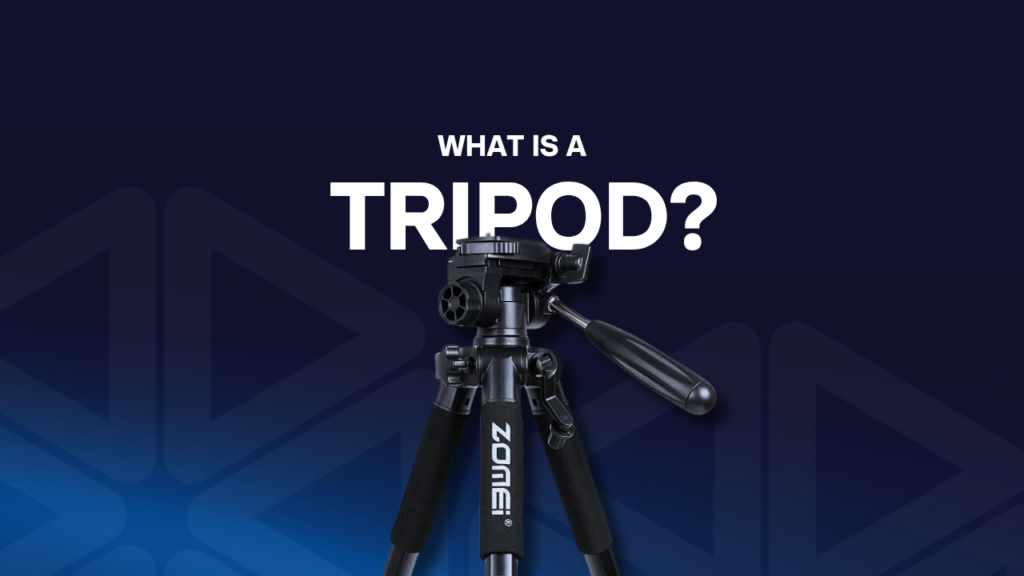
A tripod is one of the oldest and simplest pieces of film gear. Three legs, an adjustable head where the camera mounts, and sometimes a center column to raise or lower the height. Its job is to keep the camera still.
That sounds basic, but it does more than just stop shake.
A tripod lets you frame a shot exactly. Once you set the shot, it stays set. The framing you decided on at the start of the take is the same framing at the end.
It lets you hold long takes. Your arms get tired holding a camera after a minute. A tripod can hold a shot for hours.
It frees you up to do other things. With the camera on a tripod, you can check focus, listen to the audio, watch your levels, and talk to the person on camera. Holding the camera by hand takes constant attention just to keep the shot steady.
It allows smooth camera moves. Pans and tilts on a good tripod head are controlled and steady in a way handheld moves can’t match.
It makes certain techniques possible. Time-lapse, long exposure, focus stacking, and multi-pass compositing all need the camera to stay perfectly still between frames or takes. Only a tripod makes that reliable.
In short: a tripod is what turns a camera into a real piece of professional equipment, instead of just a thing being held.
Tripods come in two main types that look alike but behave differently.
Photo tripods are built for still photography. The head is usually a ball head: the camera tilts freely in any direction, then locks in place. That works for stills, where you frame the shot, lock it, and shoot. It does not work well for video, because you can’t smoothly pan or tilt during a shot.
Video tripods have fluid heads. The head moves smoothly side to side (pan) and up and down (tilt), with adjustable resistance (called “drag”) that controls how heavy the movement feels. This lets you do controlled, professional-looking pans and tilts during a shot, which a ball head simply can’t do.
You can use a photo tripod for static video shots in a pinch (lock the head and leave it). You can use a video tripod for stills too (it works fine, it is just heavier and bulkier). For any serious video work, a fluid-head video tripod is the right choice.
A couple more things worth knowing:
Legs and heads are often sold separately. The legs give you stability and height, and the head gives you the camera mount and the movement. Professional setups pair good legs with a good head, each picked for the specific job.
Weight rating. Every tripod has a maximum weight it can hold. Putting too heavy a camera on too light a tripod gives you shaky shots and risks the whole thing tipping over. Match the tripod’s weight rating to your full camera setup: the body, the lens, and any accessories.
A tripod is the default for many kinds of shots.
Interview footage. Almost always on a tripod. The camera does not move during the take, the framing stays consistent, and the shot is steady.
Product shots. Almost always a tripod. Precise framing, smooth movement when you want it, steady results.
Wide establishing shots. Almost always a tripod. Holding a wide shot by hand reveals every tiny wobble, which looks unprofessional unless you meant to do it.
Time-lapse and long exposure. Always a tripod. Holding these by hand is just not possible.
News and documentary interviews. Almost always a tripod, often with a wireless clip-on mic and a single operator.
Studio and controlled setups. A tripod is the default unless there is a specific reason to go handheld.
Some shots, though, are better handheld:
Action sequences. A handheld camera adds energy and a sense of being right there. Plenty of action films and documentaries use handheld on purpose.
Documentary on the move. When the subject is moving and the location is busy, the camera moves with it.
Style choices. Some directors prefer handheld for the feel: less polished, more present, more “you are there.” Paul Greengrass-style action filmmaking is a classic example.
Run-and-gun coverage. Weddings, sports, news events. The action is unpredictable, so the camera has to follow it.
The general rule: tripod by default, handheld by choice. A lot of amateur video looks amateur partly because of unintended handheld shake.
A few features separate good video tripods from the less useful ones.
A fluid head. Mentioned above, and essential for video. Good fluid heads have adjustable drag, a counterbalance to hold the camera’s weight, and smooth movement across the full range.
Stable legs. Carbon fiber legs are lighter and soak up vibration. Aluminum is cheaper and tougher. For studio work, weight matters less. For travel and run-and-gun, lighter is better.
Height range. A tripod that does not reach high enough won’t get the camera up to a tall subject’s eye level. One that does not get low enough won’t allow ground-level shots. Most quality tripods reach from about 1 foot off the ground up to about 6 feet at full extension.
Weight rating. Match it to the heaviest camera setup you will use. A small mirrorless camera with a light lens needs far less rating than a cinema camera with a heavy lens.
A quick-release plate. A small plate that screws to the camera and clips onto the tripod head. It lets you mount and remove the camera in seconds. Almost every modern video tripod has one.
A bubble level. A small level on the tripod or head helps you keep the camera straight. Modern cameras often have a built-in digital level, but a physical one on the tripod is sometimes quicker.
A spreader. A piece that connects the legs and locks them at a set spread. Common on heavier studio tripods, less common on travel models.
For run-and-gun video, a 200 to 400 dollar tripod setup is the sweet spot. For broadcast and high-end work, 1000 to 5000 dollar systems offer reliability and smoothness that justify the cost. For occasional use, cheaper tripods are fine for static shots but tend to feel cheap during pans and tilts.
A tripod is one of those things where the difference between “shot on a tripod” and “shot by hand” jumps right out in the final video. Footage that was supposed to be steady but came out shaky is one of the more common problems in self-shot content. A Clipmasters editor can rescue some of it with stabilization tools, by cropping in and smoothing the motion, but that usually leaves the picture a little softer than the original. Using a tripod by default and going handheld only by choice is one of the cheapest, highest-payoff habits in everyday video.
For most video work, yes. Interviews, product shots, establishing shots, time-lapse, and any shot that needs to stay still all benefit from a tripod. Handheld is a deliberate creative choice for specific situations like action, documentary on the move, or a particular style. For everyday talking-head video, tripod by default is the right call.
Photo tripods use ball heads that tilt freely and lock in place. Video tripods use fluid heads that allow smooth, controlled pans and tilts during a shot. A photo tripod works for static video but can't do smooth movement. A video tripod can do both. For any serious video work, choose a video tripod with a fluid head.
For occasional use, a 50 to 150 dollar entry-level tripod works fine for static shots. For regular video, 200 to 400 dollar setups with good fluid heads are the sweet spot. For broadcast and high-end commercial work, 1000 to 5000 dollar systems offer reliability and smoothness that justify the cost. Match the spend to how often you will use it and how heavy your camera setup is.
A fluid head is a tripod head built for video, using internal fluid resistance to give you smooth, controlled pans and tilts. The "drag" (the resistance) is adjustable, so you can dial in how heavy or light the movement feels. Good fluid heads produce smooth camera moves that handheld or photo-style ball heads can't match.
Yes, and many genres do. Handheld camera work is a deliberate style in action films, documentary, run-and-gun event coverage, and certain narrative work. Modern in-body stabilization in mirrorless cameras and phones makes handheld smoother than it used to be. Tools like gimbals (motorized stabilizers) give you results somewhere between true handheld and a tripod.