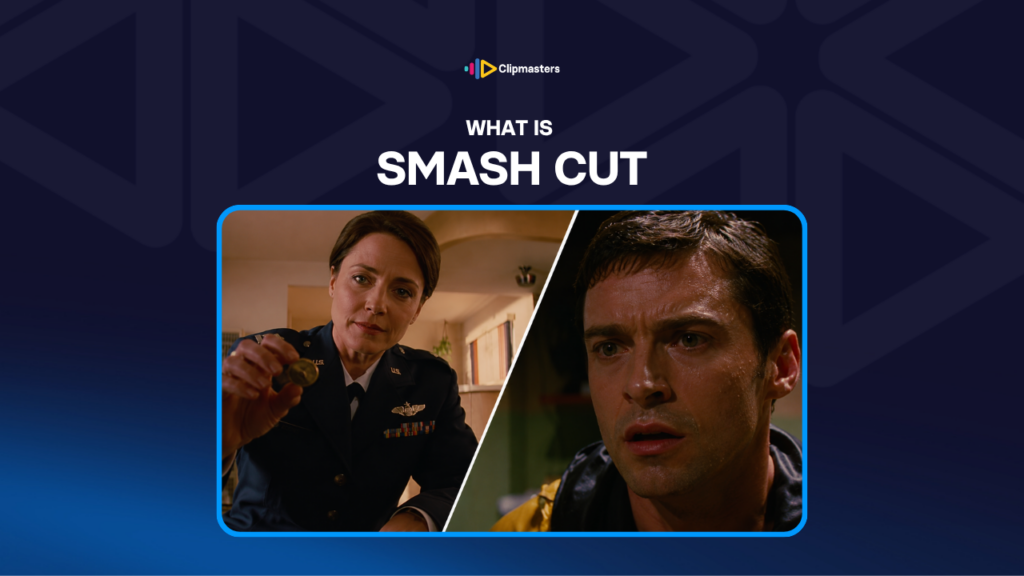
A smash cut is a jarring transition on purpose. The editor cuts straight from one scene to another that is very different in content, tone, or look. There is no fade, no dissolve, no transition graphic. Just an abrupt jump from one to the other.
The effect comes from the contrast. The two scenes feel mismatched, so the cut between them hits like a slap or a shock. Done well, it can be:
The term “smash cut” is used loosely today. Some editors use it for any abrupt or shocking cut. Others save it for the specific comedic effect of a contrast-driven jump. The lines are not strict.
What makes a smash cut land is the strength of the contrast. A smash cut between two similar scenes feels weak. A smash cut between two scenes that could not be more different feels strong. The bigger the gap, the bigger the impact.
A smash cut is different from a regular cut in how much it shows off. A regular cut is invisible, quietly joining two scenes without drawing attention. A smash cut is loud, and it deliberately calls attention to the jump.
Smash cuts are common in certain genres and formats.
For most professional video, smash cuts are used sparingly. One or two well-placed smash cuts land much harder than constant smash cutting. Overuse waters the effect down.
A few famous smash cuts from film history.
The technique works because contrast creates surprise, and surprise gets a reaction. Whether that reaction is laughter, shock, or curiosity depends on the cut.
Smash cuts work best when:
Smash cuts do not work as well when:
For commercial and online video, smash cuts are tools for specific moments, not your default editing style. One well-placed smash cut in a 90-second video can land harder than 10 in a row.
The smash cut is powerful when it is earned and weak when it is overused. At a moment with real contrast, like expectation versus reality or calm versus chaos, it can be the most memorable edit in a whole video. A good editor treats it as punctuation, not a default style: they earn the cut with what comes before, deliver the impact with what comes after, and reach for it only when the moment justifies it. At Clipmasters, that judgment comes built into the edit.
A smash cut is an abrupt cut between two contrasting scenes. A jump cut is a cut within the same scene that creates a visible jump in time or position. Smash cuts play up the contrast between different content, while jump cuts play up the discontinuity within similar content. Both are abrupt, but they do different jobs.
They are close, but not quite the same. A hard cut is any cut with no transition, no fade or dissolve. A smash cut is a specific kind of hard cut that plays up the contrast between the two scenes. So every smash cut is a hard cut, but not every hard cut is a smash cut. Most cuts in modern editing are technically hard cuts, but only the ones with strong contrast count as smash cuts.
In setup-and-payoff jokes. A character sounds confident, "this is going to work perfectly," then a smash cut to the disaster. Or a character makes a claim, then a smash cut to evidence that proves them wrong. The gap between expectation and reality drives the laugh. Smash cuts are one of the most common comedy editing tools in modern film and TV.
Selectively. Premium brands often avoid smash cuts because they can feel disruptive. Consumer-facing brands and campaigns that lean energetic or funny can use them well. It comes down to the brand's voice. A traditional financial-services brand probably should not use them, while a consumer-tech brand might use one for a product reveal.
There is no special trick. You just cut straight from one clip to the next with no transition. The "smash" comes from picking clips with strong contrast, in content, tone, sound, or look. The cut itself is a regular cut. It is the setup and payoff of the two clips side by side that makes it a smash cut.