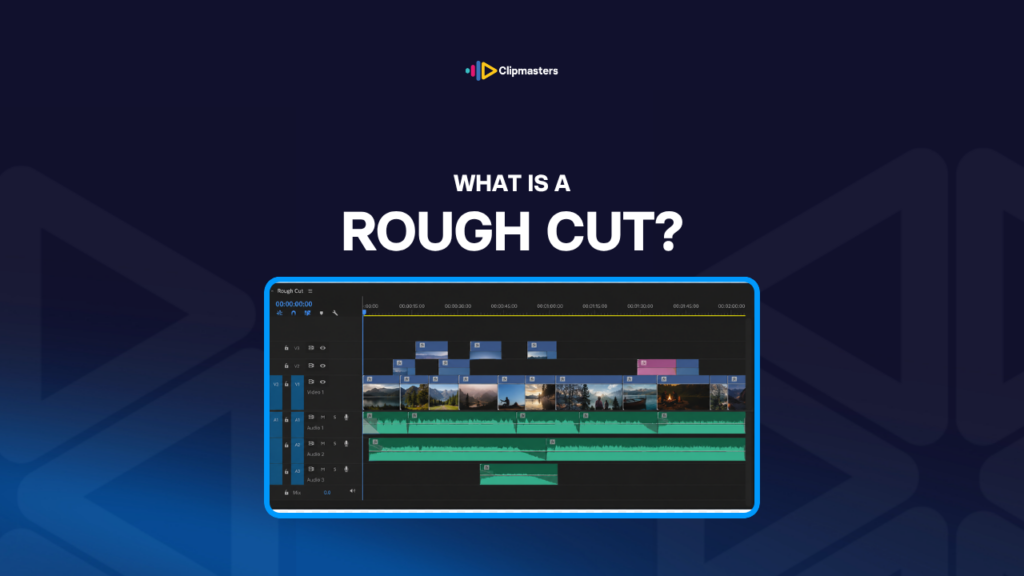
A rough cut is the first version of a video that plays all the way through, start to finish.
The structure is in place. The shots are in the order the editor intends. The video is roughly the right length. The story is there. It just isn’t polished yet.
A rough cut sits in the middle of the process. Before it comes the assembly, where all the takes are laid out in order but nothing has been trimmed. After it comes the fine cut, where pacing, transitions, music, and details get refined. Think of the rough cut as the first draft of the edit.
Here are the usual stages a video moves through:
At the rough cut stage, you can usually expect:
A rough cut is meant to look unfinished. Its job is to show whether the structure works, not to look pretty. When people watch a rough cut, the question to ask is “does this story hold together?” not “does this look professional?“
For most projects, the rough cut is the first version anyone outside the editor sees. The editor builds it from the assembly, then shares it for feedback.
The rough cut does a few specific jobs in the editing process.
It shows whether the structure works. Until the whole video plays from beginning to end, it is hard to know if the order is right. A scene that feels great on its own might feel wrong next to what comes before and after. The rough cut is the first time everyone can see the full shape.
It catches problems early. Missing shots, coverage gaps, pacing issues, structural problems: these all show up at the rough cut stage. Fixing them now is cheap. Fixing them after the fine cut is expensive.
It gives people something real to react to. It is much easier to give useful feedback on a rough cut than on a script or a storyboard. The video exists. People can watch it and respond.
It sets the foundation for the fine cut. Pacing, music, sound design, motion graphics: all of these need a working structure to build on. The rough cut is that base.
It shows the real timing. A script that read as “about two minutes” might run three minutes once it is assembled. The rough cut is the first time the actual length becomes clear.
It tests the brief. Sometimes the rough cut shows that the original plan was off. The video meant to be about one thing turns out to be more interesting about another. That conversation can reshape the whole project.
For commercial work, the rough cut is usually the first round of client review. The editor sends it over, the client gives notes, and the editor addresses them in the fine cut. Sometimes a few rough cut rounds are needed before the structure feels right.
The exact workflow shifts from project to project, but the basic steps stay the same.
Start from the assembly. The editor begins with all the takes laid out in script order, or in time order for unscripted work. Nothing is trimmed yet. Everything is on the timeline.
Pick the best takes. When there are several takes of the same scene, the editor narrows them down to the best one, or the best moments from a few. The leftovers get marked as alternates and set aside.
Trim each clip. Every clip gets shortened to its essential moments. The loose seconds before and after the action get cut away.
Put the scenes in story order. Scenes get placed in the order the story wants, which may differ from the order they were filmed. For unscripted content, the editor shapes it into a structure.
Add transitions. Mostly hard cuts, with the occasional fade or dissolve at a major scene break.
Add placeholders. Title cards go in as plain text. Music goes in as a temp track, often a royalty-free song or a track borrowed from another project, just to test the timing.
Clean up the audio enough to follow. The dialogue is audible but not balanced. Big audio problems get flagged, not solved.
Export and share. The rough cut goes out to the team through a review platform like Frame.io, Vimeo, or an unlisted YouTube link. Notes come back, and the next version begins.
For most projects, the rough cut takes 30 to 50 percent of the total editing time. The fine cut and finishing stages take the rest.
A few patterns make rough cuts harder to react to.
Too polished. Some editors over-polish, adding music cues, lower-thirds, and detailed sound work before the structure is even approved. That wastes time if the structure changes, and it pulls people into judging the polish instead of the shape. A rough cut should look rough.
Too rough. The opposite problem. A rough cut so rough that no one can follow it: missing audio, placeholder shots dropped into the middle of scenes, mismatched aspect ratios. The rough cut should be rough on polish, not rough on watchability.
The wrong temp music. Temp music shapes how the cut feels. A track that is too emotional or too energetic can give people the wrong idea about the final piece. Pick temp music that is close in tone to the final, even if it isn’t the exact song.
Too long. Rough cuts often run 10 to 30 percent longer than the final. That is normal. But a rough cut that is twice the target length is exhausting to watch and harder to give notes on. Trim it down before sharing.
Messy feedback. Several people giving conflicting notes with no clear order of who decides. A better way is to gather everyone’s feedback, then let a single decision-maker resolve the conflicts before the editor starts the next version.
Trying to fix everything now. Some things shouldn’t be solved at this stage. Detailed sound design, color grading, motion graphics: these come later. Fixing them in the rough cut means redoing them if the cut changes.
Skipping the assembly. Jumping straight from raw footage to a “rough cut” without an assembly pass usually produces a cut shaped by what the editor remembers, not by what the footage actually holds. The assembly is a separate stage for a reason.
For commercial work, keeping the rough cut, fine cut, and finishing stages clearly separate saves a lot of time. Each stage has its own decisions. Mixing them together just creates confusion and rework.
The rough cut is one of the most important moments in any project. It is the first time your whole video exists as one piece, and the choices made here shape everything that follows. At Clipmasters, your editor treats the rough cut as a real milestone: rough on polish, but careful about structure, so you can see the shape of the finished video and give clear feedback before the detail work begins.
An assembly is all the takes laid out in order, with nothing trimmed or shaped. A rough cut is the first version where shots have been chosen, trimmed, and arranged into a structure that holds together. The assembly is the raw material. The rough cut is the first real attempt at building something from it.
Usually 30 to 50 percent of the total editing time. For a 90-second commercial, the rough cut might be a day or two. For a feature film, it could be weeks. It depends on how much footage there is, how complex the project is, and how many rounds of revisions you go through. The rough cut is often the longest single stage of editing.
Usually yes, but as temp music rather than the final track. Temp music helps you judge the timing and pacing. It also shapes how the cut feels emotionally. Pick something close in tone to what the final will be, even if it isn't the exact track you plan to license.
Focus on structure and content, not polish. Does the order work? Does anything feel missing or extra? Does the pacing make sense at a high level? Is the message clear? Try to skip notes about color, sound design, motion graphics, or specific transitions, since those come at the fine cut stage. Rough cut feedback is about whether the foundation is right.
For commercial work, usually one to three rounds of rough cut review before moving to the fine cut. Each round addresses structural feedback. For bigger projects, like a feature film or a job with many stakeholders, you might need more. Once the structure feels settled, the project moves on to the fine cut for polishing.