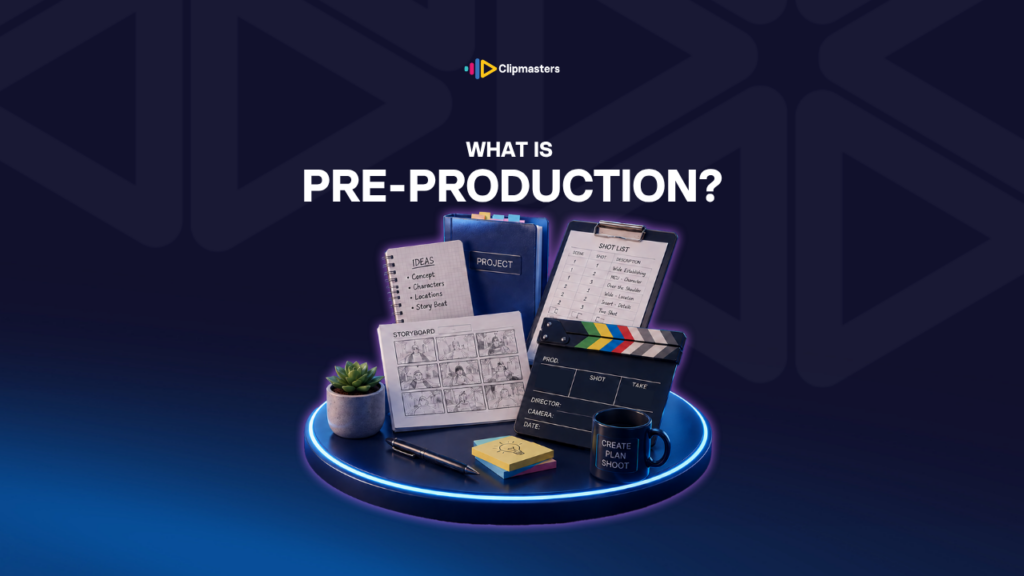
Pre-Production

Pre-production is the planning stage of a video project, everything that happens before filming begins, including scripting, casting, location scouting, scheduling, and budgeting.

In this article

Related Terms

Start Video editing now

What is Pre-Production?

Every video project goes through three stages: pre-production (the planning), production (the filming), and post-production (the editing and finishing). Pre-production is where the project gets defined, before any cameras roll.

Here’s the work that happens in pre-production:

  • Concept and script. What is the video about? What’s the structure? What gets said and shown? For narrative work, that means a screenplay. For commercial and online video, it might be a treatment, a shooting outline, or a list of interview questions.
  • Casting. Choosing the people who’ll appear on camera. For narrative film, that’s full auditions. For commercial work, it might mean hiring talent or briefing the founder and team. For interviews, it’s prepping the subjects.
  • Location scouting. Finding and locking in the places where you’ll film. Visiting sites, taking reference photos, checking for sound problems, and sorting out permits.
  • Storyboarding. Drawing or designing the shots you plan to capture. This matters most for animated or VFX-heavy work.
  • Shot lists. A written list of every shot the production needs. Less detailed than a storyboard, but it covers the same job.
  • Scheduling. Planning the order of the shots, who needs to be where, and when. For multi-day shoots, this is a big task on its own.
  • Budgeting. Estimating the cost of crew, equipment, locations, talent, food, and everything else, then approving the spend.
  • Crew hiring. Booking the camera operator, sound recordist, lighting team, gaffer, art department, and anyone else the shoot needs.
  • Equipment booking. Renting or arranging cameras, lenses, audio gear, lighting, grip equipment, dolly tracks, drones, and anything else required.
  • Permits and clearances. Filming permits for locations, music licensing, and rights clearances for any third-party content.
  • Wardrobe and styling. What people will wear, hair and makeup decisions, and prop choices.
  • Catering and logistics. Food on set, transport, and accommodation for multi-day shoots in far-off places.

Pre-production usually accounts for 30 to 50% of a project’s total timeline. Skipping it or rushing it almost always costs more time and money once you’re filming.

Need a production partner who plans before they shoot?

Editors matched to your brand. Turnaround in as little as 24 hours.

Why pre-production matters

The most reliable sign of how smooth a shoot will be is how thorough the pre-production was.

Here are a few specific things good pre-production prevents:

Getting stuck making decisions on set. If the team didn’t decide what to shoot ahead of time, they have to decide on the day. Every minute spent debating is a minute the crew is being paid to stand around. Pre-production settles those decisions in advance, so the shoot is about doing, not deciding.

Coverage gaps. Without a shot list or storyboard, important shots get missed. The editor finds out later that there’s no reaction shot, no establishing wide, no cutaway to the product. Pre-production catches these gaps before the camera rolls.

Location problems. Without scouting, the crew shows up to find trouble: bad acoustics, no power outlets, harsh light, distracting backgrounds. Scouting ahead reveals those issues while there’s still time to pick a different spot.

Permits and clearances. Filming without the right permits can shut a shoot down. Music or content used without clearance can block you from publishing. Pre-production handles the legal side before it becomes a problem.

Budget overruns. Without a clear budget, costs creep up: an extra crew member here, an extra rental day there. Pre-production sets the budget and forces real decisions about what you can afford.

Talent and crew availability. Booking people at the last minute costs more and limits your options. Pre-production books them while they’re still free.

Coordinated logistics. Multi-location shoots, multi-day projects, and complex setups only work when the logistics are planned. Pre-production keeps all the moving parts in sync.

The classic mistake is treating pre-production as overhead. The teams that try to “save time” by cutting it short almost always lose more time on set than they would have spent planning.

Pre-production for different project sizes

The scale of pre-production changes a lot depending on the project.

Feature film and TV drama. Pre-production can take 3 to 12 months: casting, location scouting, building sets, storyboarding, rehearsals. For a film, the pre-production can run longer than the actual shoot.

Commercial (30 to 60 second TV spot). Usually 2 to 6 weeks. Concept development, casting, location scouting, getting the treatment approved by the client, and booking equipment. Heavy commercials match feature film in how much detail goes into each second of finished video.

Music video. 1 to 4 weeks. Concept, locations, casting (often the artists themselves), styling, and crew booking.

Documentary. This varies enormously. Some documentaries plan a lot, especially when filming certain subjects requires permissions, travel, or coordination. Others are run-and-gun with almost no pre-production. The planning usually focuses on access, subjects, and locations.

Corporate or brand video. 1 to 2 weeks. Concept, script, casting (often internal team members), location scouting (often the client’s office), and equipment booking.

YouTube long-form. Anywhere from minutes to days. Some creators write detailed scripts and storyboard their videos. Others film off the cuff. The depth of planning tends to track with the production quality.

Social short-form (TikTok, Reels). Often minimal. A creator might plan a 30-second video for 10 minutes, then film it in 5. Heavy pre-production is rare in this format.

Live event coverage. A different kind of planning. You’re not writing the content (that’s happening live), but you are coordinating coverage: which cameras go where, what to capture, and how to handle audio from several sources.

The scale should match the project. Over-planning a quick social video wastes time. Under-planning a big commercial wastes money on set.

Common pre-production mistakes

Here are a few patterns that reliably cause trouble on shoots:

No clear creative vision. The planning happened, but no one is sure what the video is actually supposed to be. Different people on the team picture a different look, message, or structure. The disagreement only surfaces on the shoot day.

No shot list or storyboard. The team has a concept but no concrete plan for what to capture. Coverage gaps then show up in editing.

Not enough location scouting. The location was booked from a photo without anyone visiting. On the day, problems appear that someone could have spotted in person.

Underestimated time. Every shoot takes longer than planned. A schedule with no buffer for the inevitable delays forces compromises during the day.

Wrong crew size. Too few crew for a complex shoot, or too many for a simple one. Either way wastes budget.

Equipment misses. Forgetting to book a critical piece of gear, like a specific lens, a wireless mic system, or a slider, only reveals itself once the shoot starts.

No backup plan. What if it rains out the location? What if the talent doesn’t show? What if the camera fails? Pre-production should include a plan for the most likely problems.

No client sign-off before the shoot. For commercial work, filming before the client has approved the concept and script can lead to expensive reshoots when they don’t like the result. Approvals belong in pre-production, not after the fact.

Finishing pre-production properly before you start filming is one of the most cost-effective habits in video work. Every problem solved on paper is a problem you don’t have to solve on set.

How Clipmasters Uses This

Pre-production is where most of the cost-saving happens, because decisions made on paper are cheap and decisions made on set, with crew on the clock, are not. The discipline that pays off most is a simple shot list: a written rundown of every shot you need, organised by location. With it, your editor almost never finds a coverage gap in the rough cut. Without it, those missing wides and reaction shots show up too late to fix.

Frequently asked questions

What's the difference between pre-production and production?

Pre-production is the planning stage: scripting, casting, location scouting, scheduling, budgeting, and booking equipment. Nothing is filmed yet. Production is the filming itself, the actual shoot days when cameras are rolling. Pre-production usually takes longer than production, since a one-day shoot might have weeks of planning behind it.

How long does pre-production take?

It depends on the project. Feature films: 3 to 12 months. Commercials: 2 to 6 weeks. Music videos: 1 to 4 weeks. Corporate or brand video: 1 to 2 weeks. YouTube long-form: minutes to days. Social short-form: minimal. As a rough rule, pre-production is 30 to 50% of the total timeline, and more for larger projects.

What's a "treatment"?

A treatment is a document that describes a video project before it's made, a written version of what the finished piece will look and feel like. It's used in pre-production to get client approval, secure financing, or get the creative team on the same page. Treatments range from a paragraph for simple work to dozens of pages for big commercials and films.

Do I need pre-production for a quick social video?

Some planning, yes, but the scale should match the project. A 30-second TikTok doesn't need a 50-page treatment. It might just need 5 minutes to think through the concept, the location, what to wear, and what to say. Pre-production scales with the project, and even quick videos benefit from a few minutes of planning.

What's a "shot list" vs a "storyboard"?

A shot list is a written list of every shot the production needs, often organised by location or setup. A storyboard is a visual version of that same plan, with sketches or images showing what each shot looks like. Both do the same job (planning coverage). The difference is whether the plan is written or drawn. Many productions use both: a storyboard for the key sequences plus a shot list for everything else.

Loading video…