Mise-en-Scène

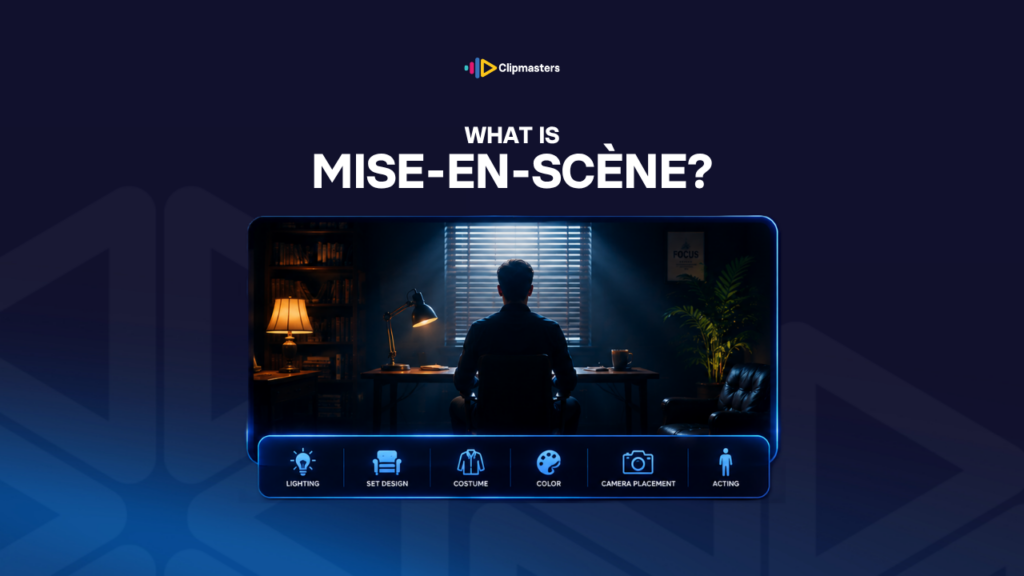
Mise-en-scène (French for “placing on stage”) refers to everything that appears within a film frame: set, costume, lighting, props, blocking, and composition.

In this article

Related Terms

Start Video editing now

What is Mise-en-Scène?

Mise-en-scène is one of those French film terms that sounds intimidating until you hear what it really means. Translated literally, it means “placing on stage.” In plain terms, it means everything that ends up inside the frame of a shot.

That includes:

  • The set. The real or built space where the scene happens.
  • The props. Every object you can see in the frame, whether it is front and center or off in the background.
  • Costume. What the characters are wearing.
  • Hair and makeup. How the characters’ looks are styled.
  • Lighting. The light sources, plus their color, strength, and direction.
  • Blocking. Where the actors stand and how they move through the space.
  • Composition. How the camera frames it all.
  • Color. The main color palette of the scene, often shared across the set, costume, and lighting.

The term comes from theater, where it meant the staging choices a director made for a play. Film borrowed it in the 1920s and used it for everything you can see inside a shot. By the 1950s, French critics had built a whole way of studying film around it. They argued that great directors showed their vision mostly through these in-frame choices, more than through editing or storytelling.

For everyday use today, mise-en-scène is a handy catch-all for “everything that goes into how a shot looks, beyond just the camera setup.”

Need editors who care about every detail in the frame?

Editors matched to your brand. Turnaround in as little as 24 hours.

Why mise-en-scène matters

A few reasons directors and camera people think hard about mise-en-scène.

It tells the story. Everything in the frame says something. A character’s room reveals who they are without a word of dialogue: the books they keep, the photos on the wall, whether the bed is made, the color of the paint. The audience reads all of it, even when they do not realize they are doing it.

It sets the mood. A scene lit warmly with golden lamps and soft furniture feels nothing like the same scene under cold, harsh office lights. The dialogue can be word for word the same, but the feeling is completely different.

It pulls everything together. Strong mise-en-scène ties a film’s whole look together. The colors, the set choices, the lighting style, the costumes, all working as one, build a believable world the audience can settle into.

It rewards a second look. Films with strong mise-en-scène hold up to repeat viewing because there is always more to spot in the frame. The set has details you missed the first time. The costumes hint at things you did not catch. A film with weak mise-en-scène just does not have that depth.

Here is a useful test: pause any frame of a film with strong mise-en-scène. Does the image feel complete on its own? Could you describe the whole world from that single still? In great films, almost always yes. In weaker ones, the frame often shows just the action, with no surrounding world designed around it.

Mise-en-scène in different kinds of production

The term started in feature film, but the idea applies to almost any kind of video.

Feature film and scripted TV. Mise-en-scène is a central concern here. Production designers, costume designers, camera people, and directors all work together on every visible detail. A single scene can take days to dress and light properly.

Commercial and ad work. Mise-en-scène is essential, especially for luxury, lifestyle, and brand films. The viewer is meant to link the brand with a certain visual world, and everything in the frame helps build that world.

Documentary. Mise-en-scène matters but works differently. The location usually already exists rather than being built. The director’s job is more about choosing where to point the camera in a real space than designing that space from scratch.

Vlogs and YouTube. Looser mise-en-scène, but it still matters. The background, the lighting, the clothing, the on-screen graphics, all of these shape how the content reads. Strong creators plan their video “look” carefully, even when the setup is casual.

News and corporate video. Mise-en-scène is usually kept simple: a clean background, a basic light, professional clothing. The look is deliberately plain so the message stays front and center.

For any kind of video, the question “what’s in the frame?” deserves a real answer, not an accidental one. Most amateur video looks amateur because of mise-en-scène choices made by default: the room as it happened to be, the clothes the person happened to wear, whatever lighting the location happened to have, rather than choices made on purpose.

Common mise-en-scène mistakes

A few patterns that give away amateur or accidental mise-en-scène.

Cluttered backgrounds. The background has distracting stuff in it: a messy desk, clashing colors, random objects, busy patterns. The eye does not know where to look. The fix is to think about the background before you set the camera.

Costume mismatches. Clothing that does not match the character or scene. A casual hoodie in a formal setting, a bright shirt in a moody scene, a logo that fights the brand. The fix is to plan the costume alongside the rest of the look.

The wrong color palette. A set, costume, and lighting that do not share one color world. The frame feels visually split. The fix is to pick one main palette (warm, cool, single-color, or complementary) and bring the pieces in line with it.

Lighting that fights the scene. A “morning” scene lit with cold blue light. An “intimate dinner” lit by harsh overhead office lights. The fix is to light for the mood the scene wants, not just so people can see.

No production design at all. The scene is filmed exactly as found. No props added, no thought about the frame, no costume planning. The fix is to take five minutes before each shot to look at the frame and ask, “does anything need to change?

For commercial work especially, the gap between professional and amateur often comes down to mise-en-scène discipline more than the camera or the editing.

How Clipmasters Uses This

Mise-en-scène is mostly a shoot decision, not an edit one. By the time footage reaches your Clipmasters editor, the world inside the frame is already locked in. An editor can crop, reframe, and grade, but they can’t change what is on the wall behind you or what you chose to wear. When footage arrives with strong mise-en-scène, your editor can shape it into something polished much faster, so a few minutes of thought before you press record pays off all the way through the edit.

Frequently asked questions

How do you pronounce mise-en-scène?

Roughly "meez-on-sen" (the "scène" rhymes loosely with "sen" rather than with "scene"). The full French version is closer to "meez-ahn-sen." Both are understood in English-speaking film circles. Some film schools insist on the French pronunciation, but in everyday work either one is fine.

Is mise-en-scène the same as production design?

Closely related, but not the same. Production design is the hands-on craft of designing and building the visual world: sets, props, and coordinating costume. Mise-en-scène is the bigger idea that includes production design plus blocking, framing, lighting, and how everything appears in the frame. Production design builds the world, and mise-en-scène is that world as it ends up filmed.

Does mise-en-scène apply to short-form social video?

Yes, even if the term feels too fancy for the format. Every TikTok or Reel has mise-en-scène: the location, the lighting, the clothing, the on-screen graphics. Strong short-form creators plan these on purpose. The video does not have to be elaborate, it just has to be intentional.

What's the difference between mise-en-scène and cinematography?

Mise-en-scène covers everything inside the frame: set, costume, blocking, lighting, props. Cinematography covers how the frame is captured: camera placement, lens choice, camera movement, exposure. The two overlap on lighting, since both work with light, but otherwise they focus on different parts of how a shot looks.

Who is responsible for mise-en-scène on a production?

On a feature film, several roles share it: the director, the production designer, the camera person, the costume designer, the props master, and the location scout all pitch in. The director makes the final calls. On smaller productions, one person often wears several of those hats. On a one-person shoot, the videographer is the entire mise-en-scène team.

Loading video…