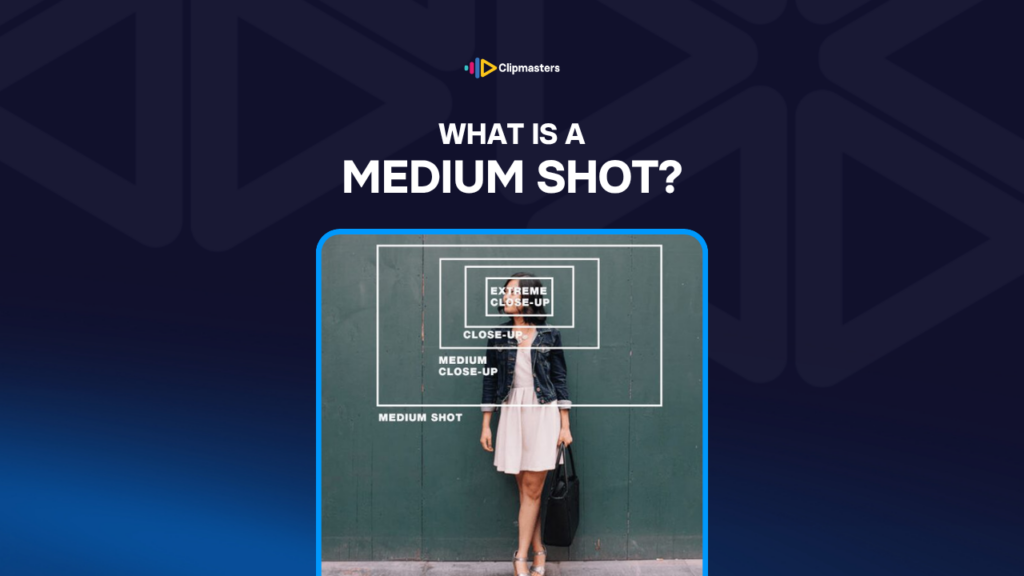
A medium shot frames a person from about the waist up to just above the head. The subject sits in the middle of the frame, with some of the surroundings showing above, below, and to the sides. It looks roughly like what you would see while chatting with someone at a normal distance.
The medium shot is the everyday default in both story and commercial work. Most conversation scenes are built on medium shots, with closer and wider shots added for variety.
Here are the common types of medium shot.
Here is the job the medium shot does in a scene.
For commercial work, medium shots are the backbone. Interviews are usually medium shots. Talking heads are medium shots. Product demos often use medium shots so you see both the presenter and the product. Brand films use them constantly.
Here are the main reasons medium shots do so much of the work in video.
It feels normal. People are used to seeing conversations at this framing. The medium shot reads as natural because it matches how we see each other in daily life.
It shows body language. Gestures, posture, and how someone holds themselves say as much as a face. Medium shots catch all of it: hands moving while they speak, shoulders shifting, posture changing. Close-ups lose that.
It shows the person and the setting. The viewer sees the subject and some of their surroundings at once. You get both, without cutting to a separate shot.
It is easy to watch for a while. Medium shots can stay on screen longer than close-ups without feeling cramped. A whole conversation can play out in medium without wearing the viewer out.
It cuts well in any direction. Medium shots cut comfortably to close-ups (tighter), to long shots (wider), or to other mediums from different angles. Sitting in the middle of the scale makes them flexible.
It supports performance. Actors can use their whole upper body in a medium shot. Close-ups force face-only acting, while the medium opens the performance up.
It is quicker to set up. Medium shots are usually easier to set up than close-ups, which need careful focus and lighting, or long shots, which need careful framing. So the shoot can move faster.
It is what people expect. Most interviews, testimonials, and explainers are shot in medium. Audiences expect it, so stepping away from it should be on purpose.
It packs in a lot. A medium shot carries more information per frame than a close-up (just the subject) or a long shot (a big space with a small subject).
It suits brand and presenter videos. Founders, presenters, and spokespeople almost always appear in medium shots. The framing balances authority (the person is the focus) with warmth (you see their body and gestures).
For commercial work, the medium shot is the default for conversation, interviews, and presenter content. It is usually the backbone, with closer and wider shots added for variety.
For story work, the medium shot is the conversation baseline. Most dialogue sits in medium, with cuts to closer for emotion and wider for context.
Here is how medium shots usually get used within a scene.
Set the subject with a medium. After a long shot of the location (or instead of one), a medium shot sets up the person. The viewer learns who to pay attention to.
Keep the conversation in medium. Most dialogue plays out in medium shots. Cuts happen at natural points, like speaker changes or reactions, but the home base is medium.
Cut to close-ups for emphasis. Strong emotional moments, big lines, or important reactions get a close-up. These break out from the medium baseline.
Cut to wider for context. Now and then, the editor goes back to a wide shot to remind the viewer where everyone is. Then back to medium for the conversation.
Use two-shots for two people. When two people talk, a medium two-shot frames them together. The editor can stay on it or cut between separate mediums of each person.
Match cuts across angles. Cutting between two medium shots of the same speaker from different angles is standard. The matching scale keeps the cut smooth.
Avoid big jumps in scale. Cutting from a long shot straight to a close-up, with no medium in between, can feel jarring. The medium often works as a stepping stone between very different scales.
Mind the composition. Even though mediums feel like the default, composition still counts: where the subject sits, the space above their head, the space they face into, the empty areas. Good framing makes a medium stronger.
Audio is easy. Medium shots usually have the boom mic close to the subject, so the sound is good. Long shots put the mic too far away, but mediums are mic-friendly.
Lighting is forgiving. Medium shots handle slightly less precise lighting than close-ups. The wider frame means small lighting issues are harder to spot.
Return to medium to refocus on the subject. After a run of close-ups or wide shots, going back to a medium puts the subject back at the center.
For most commercial work, medium shots are the backbone and make up most of the screen time. Other shots are mixed in for variety and for specific story moments.
Here are the slip-ups that make medium shots weak.
Awkward framing. Cutting the subject off at an uncomfortable point, like the elbow, the wrist, or the bottom of the chin. Good framing avoids cutting right at a joint. Cut above or below it.
Bad headroom. Too much or too little space above the head. A little headroom is right. Too much makes the person look like they are floating, and too little makes them look crammed in.
Wrong lead room. Someone facing one way should have more space in front of them than behind. Get this wrong and the framing feels off.
Everything looks the same. Several medium shots framed in exactly the same way. Small changes, like a slightly different angle or a gentle pan, add variety.
A busy background. Medium shots include some of the setting, and that setting should not fight the subject. Cluttered backgrounds and distracting objects pull the eye away.
Dull eye lines. A subject staring straight at the camera in every shot. Mixing it up, like looking slightly off camera or toward someone off-screen, helps.
No closer or wider shots. A scene made only of mediums feels flat. Without close-ups for emotion or wide shots for context, the editing has nowhere to go.
Mediums that do not match. Cutting between two mediums of the same person from very different angles can feel jarring. The shots should either match closely or differ enough that the cut clearly looks intentional.
Crossing the line. Medium shots that cross the 180-degree line make confusing cuts, where the subject seems to jump to the other side of the frame.
Lighting that changes. Several mediums of the same person lit differently. Viewers notice the mismatch.
Skipping coverage. Some shoots grab only medium shots to save time, leaving the editor nothing else to cut to. Even a few close-ups and wide shots make a big difference in the final edit.
For commercial work, the medium shot is the default, but it should not be the only one. A video made entirely of mediums feels flat, no matter how good each shot is. Adding variety in framing makes the editing better.
At Clipmasters, your dedicated editor treats the medium shot as the steady home base for your video and builds out from there with close-ups and wide shots for variety. It is the kind of framing judgment that comes with knowing your brand. It is all part of the edit, with simple jobs often back to you in as little as 24 hours.
A medium shot frames the person from the waist up. A medium close-up frames them from the chest up, a bit tighter, with the head taking up more of the frame. Both are conversational framings. The medium close-up feels a little closer while still showing some body language. It is really a matter of degree, and editors often use the two terms loosely.
Use it as your default for conversation, interviews, presentations, and most subject-focused content. Medium shots carry the bulk of the screen time in most commercial video. Some moments call for closer (a close-up for emotion) or wider (a long shot for context), but the medium shot is a safe home base for most scenes.
It is a medium shot that frames two people together. It is used for scenes where two people are talking or interacting. The two-shot catches both performances at once, and the editor can stay on it or cut between separate mediums of each person. Wider two-shots show more of the setting, and tighter ones focus on the two people and their connection.
Sometimes, but not always. A master shot is the main continuous shot of a scene, and it can be at any scale, often a wide or long shot. A medium shot is a specific framing. A medium-shot master is common for two-person conversation scenes, while a wider master is common for bigger groups or larger action.
Very. Even though the medium shot is the default framing, composition still matters: the space above the head, the space the person faces into, the balance, what is in the background, and where the subject sits in the frame. Strong composition makes a medium shot feel intentional. Weak composition makes it feel like the camera was just pointed at someone.