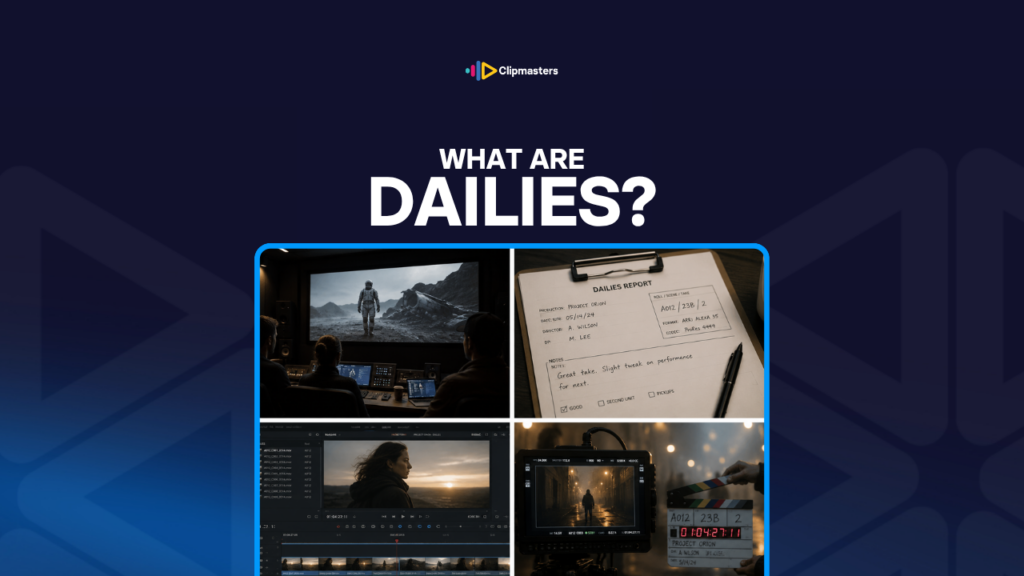
Dailies, sometimes called rushes in British production, are the raw, unedited footage from a day of shooting. The name comes from the old habit of reviewing each day’s footage the next morning, usually before the next day’s filming began.
The traditional workflow:
The modern version varies by project:
Dailies usually include:
Dailies can come as proxy video (lower resolution for fast review), raw camera files (for full fidelity), or rough assembly sequences (for narrative review).
Here are a few reasons the dailies process matters so much in professional production.
Quality control. Watching dailies catches problems early: out-of-focus shots, bad audio, lighting issues, weak performances, continuity slips. Catching them during the shoot means you can reshoot while the set and cast are still there.
Feedback to the crew. Dailies shape the director’s notes for the days ahead. “We need wider coverage on this scene.” “The lighting needs to be warmer.” “Watch the eyeline.“
The editor gets familiar. When the editor watches dailies regularly, they get to know the footage. By the time editing starts, they already know what is available and where the strongest material is.
A real look at performances. Directors can see how performances land when watched cold. Dailies separate what felt good on set from what actually plays on screen.
Continuity tracking. Continuity errors are easier to spot in dailies than later in editing. A prop in the wrong place across takes, lighting that does not match, or a wardrobe slip all get flagged early.
Color and lighting feedback. Dailies are usually viewed with at least basic color correction, so the DP can see how the lighting is reading and adjust for the next day.
Audio check. Dialogue clarity, background noise, mic problems, and other audio concerns surface during dailies.
Stakeholder updates. Producers, executives, and other stakeholders sometimes review dailies to track progress. The footage is the most direct evidence of what the production is making.
Confidence. A strong dailies session reassures the team that things are going well. A rough one signals issues that need attention.
A record. Dailies create a paper trail of what was shot, which helps with production tracking, insurance, and post-production planning.
For commercial work, dailies reviews are usually less formal than feature film. The director and editor watch the day’s footage, notes get taken, and the editor often starts assembly the same day.
For high-end work, like feature film, premium TV, and big-budget commercials, dailies are a formal part of the workflow with dedicated review sessions and real production attention.
Here is how dailies tend to work in 2026.
Capture and transfer. The camera team records to memory cards or recording media. At wrap, or during the day, the cards go to the data wrangler, who loads them into project storage.
Backup and verification. Several copies get made: a working copy, an archive copy, and an off-site backup. Each one is checked to make sure no data was lost in transfer.
Proxy generation. Full-resolution footage is rarely used for review, since the files are too big to share or stream quickly. Lower-resolution proxy video gets made instead, and that is what the team watches.
Color correction. Basic color correction goes on the proxies so they look roughly right. This is not the final grade, just enough to judge lighting and exposure.
Audio sync. Production audio recorded on a separate recorder gets synced to the video, so the dailies include matched sound.
Metadata tagging. Each clip gets tagged with scene, shot, take, camera, date, and other details. Good tags make it fast to search and organize later.
Selects. The director or script supervisor marks the chosen takes. The dailies often include only the selects, or make them easy to spot.
Distribution. Modern dailies platforms (Frame.io, Wipster, Postlab) handle secure sharing with the right team members. People watch on their own time and leave comments right on the video.
Review session. For higher-end productions, a formal review happens at the start or end of each day. The team watches together and talks it through.
Feedback to production. Notes from dailies go back to the set: reshoot lists, technical changes for the next day, performance notes, color tweaks.
Storage and archive. Dailies get archived for the length of the production and often for years after.
For most commercial productions, the workflow is compressed. The data wrangler loads everything in, proxies get made, the director reviews on the spot or that evening, and the editor starts work the next day. Formal review sessions are less common than in feature production.
For remote teams, cloud-based platforms have mostly replaced in-person sessions. Anyone can review from anywhere, the same day as the shoot.
Here are a few patterns that lead to dailies trouble.
No backup of the camera media. Reformatting camera cards before the footage is confirmed backed up. It is a disaster when it goes wrong. The industry standard is multiple backups before any media gets reused.
Slow proxy generation. Workflows that take hours to produce dailies. By the time they reach the team, it is too late to act. Modern hardware should produce dailies in close to real time.
Wrong people in the review. Reviews with people who cannot act on the feedback. Producers without authority, or stakeholders who were not meant to be there yet. Streamlined reviews work better.
Missing audio. Dailies without synced audio. The team cannot judge dialogue or sound. Audio sync should be part of the dailies prep.
No color correction. Raw camera footage often looks flat, especially log footage. Without basic correction, the team cannot judge the real look. Even a simple LUT on the dailies helps a lot.
Too much footage. Dumping every take from every angle on the team. The review gets exhausting. Selects-only reviews are more useful for most people.
Not capturing notes. Reviews happen, but the feedback never gets written down. The next day on set, the director cannot remember what they said about the lighting. Capture and share notes from each session.
Platform issues. Slow uploads, broken playback, expired links. Modern platforms work well but need setup and reliable internet. Test the platform before relying on it.
Skipping dailies entirely. Some budget productions skip them. Problems do not surface until editing. The fix is at least an informal review, even if it is just the director watching takes on the camera at lunch.
Inconsistent metadata. Some shots tagged well, others not. Missing tags make editing harder later. Consistent tagging at the dailies stage really pays off.
Wrong proxy quality. Proxies too low to judge properly, or too high to load quickly. Standard formats like 720p or 1080p H.264 at a moderate bitrate work for most reviews.
For commercial work, the dailies process is often looser than in feature production, but the same principles hold: secure the footage, make review-friendly versions, share with the team, capture feedback, and act on it.
Dailies are one of those steps that separate professional production from amateur work, because reviewing footage right away catches problems while they are still fixable. At Clipmasters, your editor likes to see the footage early, even informally, so they can flag any issues before formal editing begins instead of weeks later. That early access makes your editor a real partner in the project from day one, not just someone who shows up at the end.
They mean the same thing. "Dailies" is the American film and TV term, and "rushes" is the British one. Both describe the unedited footage from a day of shooting, reviewed by the team. Some productions treat "rushes" as the raw camera output and "dailies" as the processed review copies, but that split is not used consistently.
At a minimum, the director and editor. Often the producer, the DP, and the script supervisor too. Sometimes studio executives, key creative team members, and other stakeholders. Who shows up depends on the production type and stage. Commercial productions usually have smaller dailies groups than feature films.
In modern production, often the same day or the next morning. The old workflow had dailies arriving the day after shooting because of overnight processing, but digital workflows are faster now. Cloud platforms can deliver dailies to remote team members within hours of capture.
No. Dailies are unedited footage. The rough cut is the first edited version of the project, built from the dailies once editing begins. Dailies come before editing, and the rough cut comes out of it. Dailies are the raw material, and the rough cut is the first assembly of that material.
Usually not. Most commercial productions handle dailies informally: the director reviews takes on the camera, the editor gets the footage the same or next day, and problems get flagged through direct conversation. Formal dailies sessions are more common in feature film, premium TV, and high-end commercials with large stakeholder groups.