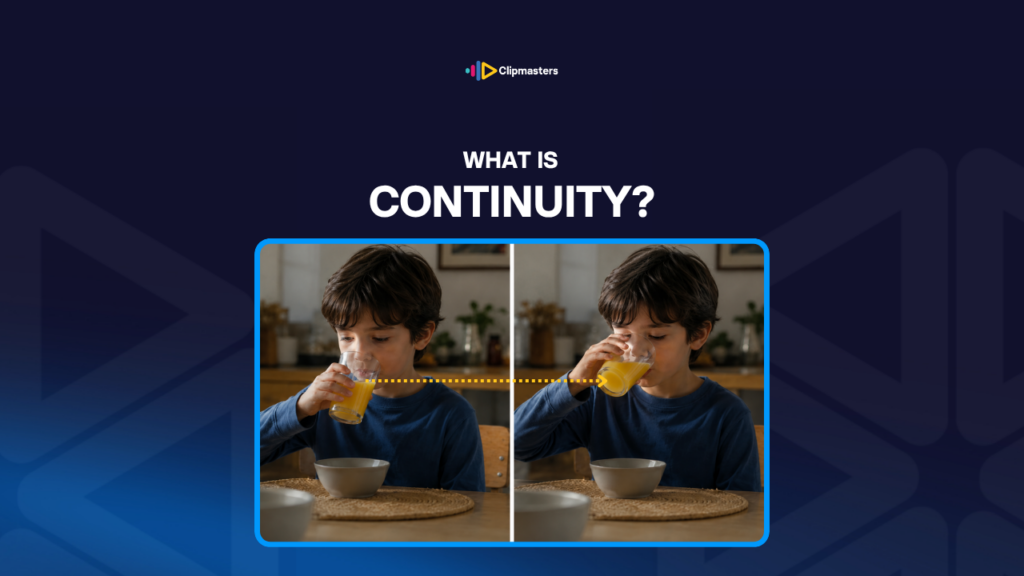
What Is Continuity

Continuity is when scene details stay consistent across cuts, so costume, props, position, lighting, and action match from one shot to the next.

In this article

Related Terms

Start Video editing now

What is Continuity in Video Editing?

Continuity means the details in a scene stay consistent from one shot to the next. If something shows up in one shot, it should look the same in the next shot, unless there is a clear reason for it to change.

Here is what continuity keeps an eye on:

  • Costume. What someone is wearing, down to small things like buttons, jewellery, a watch, or glasses.
  • Hair. The style, where it sits, whether it is up or down.
  • Makeup. Cosmetics, marks, sweat, dirt.
  • Props. The objects in the scene. Where a glass sits on a table. Whether a door is open or closed.
  • Position. Where each person stands or sits. Which hand they are using. Where they are looking.
  • Action. Whether a movement in one shot carries on the same way in the next. If a character is raising a glass, the glass should be at the same height in the next shot.
  • Lighting. The direction, brightness, and colour of the light. Shadows should fall the same way across cuts.
  • Time of day. A scene set at dusk should stay at dusk all the way through, even if it took several days to film.
  • Weather. Rain, snow, fog, wind. If it was raining in the wide shot, it should still be raining in the close-up.

When continuity breaks, it is called a “continuity error.” The audience may not notice it on purpose, but the cut feels a little off in a way they cannot always name.

A few famous ones: in Pretty Woman (1990), a croissant turns into a pancake between cuts. In Star Wars (1977), R2-D2 moves around in the background between shots. In Game of Thrones (2019), a Starbucks coffee cup turned up in a medieval scene.

Continuity errors happen in any production with lots of takes and lots of shots of the same scene. The job is to keep them to a minimum, and to make the ones that slip through invisible.

Need editors who catch continuity issues before delivery?

Editors matched to your brand. Turnaround in as little as 24 hours.

Why continuity matters

Here are the main reasons continuity is taken seriously.

It keeps the audience in the scene. When someone spots a continuity error, they get pulled out of the moment for a second. The feeling that they are watching one continuous moment breaks. Even small errors can leave a vague sense that something is off.

It signals quality. A video with visible continuity errors reads as rushed or amateur. Professional work catches and fixes these before delivery. Visible errors usually mean nobody was watching for them.

It keeps the story clear. Some errors actually confuse people. A character who moves between shots in a way that makes no sense. A prop that was destroyed in one shot and shows up whole again. These can leave the audience unsure of what is happening.

It respects the audience. People notice more now than they used to. Screens are sharper, viewers can pause and zoom on streaming platforms, and people share continuity errors on social media. Bad continuity gets spotted and passed around.

It reflects on the whole production. A small detail that holds across cuts, like a wedding ring or a clock in the background, reads as the kind of care that careful productions take. Sloppy continuity reads as the opposite.

For commercial work, continuity matters in quieter ways. Multi-camera interview footage needs the speaker’s position and gestures to hold across angles. Product shots need the same product in the same orientation from cut to cut. A polished commercial usually has tight continuity. An amateur one often does not.

For film and TV, continuity is so important that there is a whole job for it: the script supervisor, sometimes called the “continuity supervisor” or “scripty.” This person tracks every detail of every shot during filming and flags problems before they reach the edit.

Common continuity issues

Here are the issues that show up again and again in editing.

Position mismatches. A character stands one way in the wide shot and a different way in the close-up. The cut feels off because they seem to have teleported.

Hand and gesture mismatches. Someone holds a coffee cup in their right hand in one shot and their left in the next. Their hand is at chest height in one shot and in their lap in the next. These are very common in dialogue scenes because actors do not repeat gestures the same way on every take.

Prop position changes. A glass on a table is half-full in one shot and full in the next. A pen is on the left of the desk in one shot and the right in the next. Props get moved between takes, and editors do not always catch it.

Costume changes. A button done up in one shot and undone in the next. A jacket on, then off, then on again across cuts. This is common when scenes are filmed over several days.

Lighting changes. Shadows falling in different directions. The colour of the light shifting because the scene was shot over hours of changing daylight. Modern crews try to control for this, but it is hard to rule out completely.

Background mismatches. Extras in different spots across cuts. Cars in different places in the parking lot. A clock showing different times.

Audio continuity. Less visible, but it still matters. Background noise changing across cuts. Music suddenly louder or quieter. Room sound disappearing. All of these break continuity for the ear, even when the picture is fine.

Anachronisms. Modern objects in period pieces. Wristwatches in a scene set before wristwatches existed. Modern hairstyles in a historical setting. These are research slips more than shot-to-shot errors, but they get filed under continuity all the same.

For editors, this work happens during the rough cut and fine cut. A careful editor watches each cut from both sides and asks a simple question: is this still the same scene? Did anything change that should not have?

How continuity is managed

Here are the practices that keep continuity tight on a production.

Script supervisor. On film and TV shoots, one person tracks continuity throughout. They take photos of each scene, note costume and prop positions, watch the takes, and flag anything that does not line up. Their notes go to the editor.

Continuity photos. At the end of each take, the script supervisor or an assistant photographs the actor, the set, and the key props. These photos become the reference for any reshoots.

Coverage planning. Smart directors plan their shot lists so the tricky details get covered the same way every time. If a character pours a drink across several cuts, the team lines up the pouring across takes.

Multi-camera shooting. When it is practical, filming the same action with several cameras at once removes continuity issues between shot types. The wide shot and the close-up come from the same moment.

Wardrobe and prop locks. Once a costume or prop is set in a scene, the wardrobe department locks it in. The same shirt, the same tie, the same way of buttoning.

Hair and makeup checks. Between takes, hair and makeup artists check the actors against earlier shots and put the look back the way it was.

Editor-side flagging. During editing, the editor watches each cut and flags issues for the director. Some can be hidden with cutaways or a different take. Others mean the cut has to live with the error.

Reshoots. When an error is bad and clearly visible, the production may need to reshoot the shot. That means getting the cast, location, and crew back together, which is expensive, so it is done sparingly.

For commercial work, continuity supervision is usually less formal than on a feature film. The director or producer often handles it alongside other jobs. For complex multi-day commercial shoots, a dedicated continuity person becomes worth it.

For online video and creator content, continuity is often left to the editor alone. Catching issues in the edit is harder than catching them on the shoot, but the work is the same: watch each cut closely and look for things that do not match.

How Clipmasters Uses This

Continuity is one of those things that is hard to get perfect but shapes how professional a video feels. Most viewers miss the small errors. The few they do catch often become the thing they remember. A good editor spots these during the rough cut, while there is still room to pick a different take or add a cutaway, and catching one early is far easier than fixing it after sound and colour work have begun. At Clipmasters, watching each cut from both sides is just part of how your editor works.

Frequently asked questions

What's a continuity error?

A continuity error is a visible mismatch between cuts within a scene. A glass that is half-full in one shot and full in the next. A character whose hand position changes across cuts. A prop that disappears and comes back. These are common in any production and most are minor. The work is to keep them to a minimum and make the unavoidable ones invisible.

Who's responsible for continuity on a film set?

The script supervisor, also called the "continuity supervisor" or "scripty." Their job is to track every detail of every shot throughout filming. They take photos, take notes, watch takes closely, and flag anything that does not match for the director. On smaller productions, an assistant director or the producer often handles it.

How do editors catch continuity errors?

By watching each cut closely from both sides. Does the character's position match? Are the props in the same place? Is the lighting consistent? Do the gestures carry on naturally? Modern editing software lets you compare clips side by side, which helps a lot. Cutaways can hide issues that cannot be fixed by choosing a different take.

Are continuity errors important in commercial video?

Less critical than in narrative film, but still worth catching. Multi-camera interview footage needs the speaker's position and gestures to hold across angles. Product shots need the product in the same orientation. Brand films need consistent location and lighting across cuts. Catching these shows that the work was done with care.

What's the most famous continuity error in cinema?

There are a few contenders. The Starbucks coffee cup that turned up in Game of Thrones (2019). The croissant that becomes a pancake in Pretty Woman (1990). The disappearing R2-D2 in Star Wars (1977). The film crew reflected in shop windows in plenty of older films. These get shared widely now, but they are usually small details the first audiences never noticed.

Loading video…