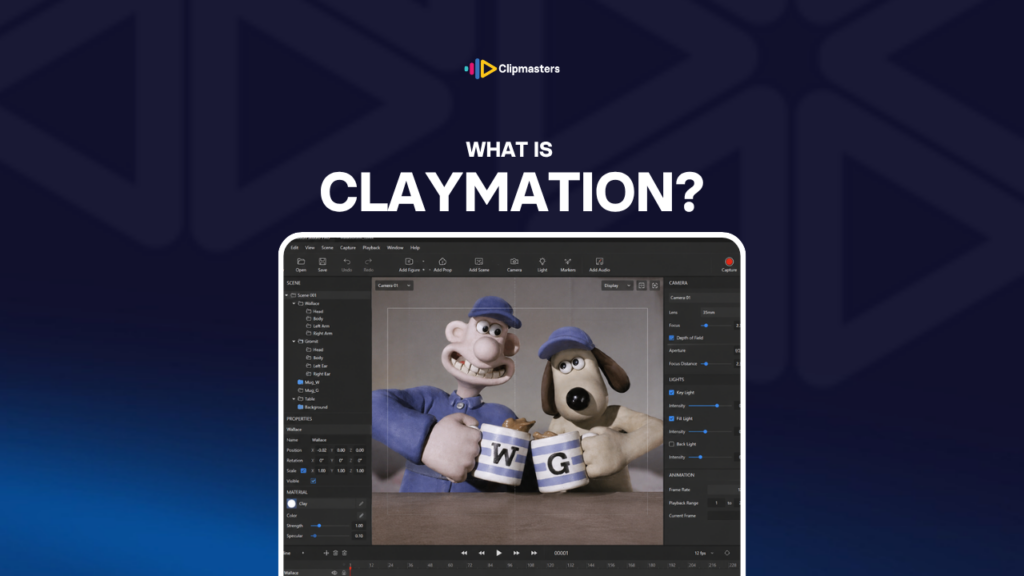
Claymation

Claymation is stop-motion animation where clay figures are photographed one frame at a time, nudged a little between each frame to seem to move.

In this article

Related Terms

Start Video editing now

What is Claymation?

Claymation is a hand-made form of animation. The animator builds figures out of clay (or a similar material like plasticine), photographs them in a pose, nudges them a little, photographs again, and repeats for thousands of frames. Play those frames back at normal speed (usually 24 frames per second) and the figures seem to move.

The word is a blend of “clay” and “animation,” coined by Will Vinton in 1978. Before that, people just called it “clay animation” or “plasticine animation.”

What makes claymation what it is:

  • Real, physical figures. The characters exist in real space. They are sculpted, posed, and photographed.
  • Stop-motion technique. One frame at a time, with a small change between each. An animator might shoot just 1 to 2 seconds of finished animation in a full day.
  • Clay or modelling material. The figures need to hold their shape but still be easy to move. Modelling clay is traditional, though some modern productions use silicone or polymer clay.
  • A distinctive look. Claymation has a recognisable feel: the slightly imperfect, hand-finished surface of the clay, sometimes a fingerprint left on a figure, a little wobble in the motion.

Claymation is a type of stop-motion animation. Other stop-motion uses puppets (Tim Burton’s The Nightmare Before Christmas), paper cut-outs (the original South Park episodes), or LEGO bricks (the LEGO Movie look). What makes claymation specifically claymation is the use of clay as the figures.

Need editors who handle any animation style?

Editors matched to your brand. Turnaround in as little as 24 hours.

How claymation is made

Making claymation is slow, careful work.

  • Building the figures. Each character is sculpted from clay. Most have a wire frame inside, called an armature, that lets the animator pose them and holds them steady. The clay goes over the frame.
  • Setting up the scene. Like a tiny stage play, the scene has sets, props, and lighting. Sets are usually built small, with figures often 8 to 12 inches tall.
  • Photographing frame by frame. A camera sits on a steady mount. The animator shoots the figure in pose one, then nudges it slightly (a hand moves a fraction of an inch, a head tilts, an expression shifts), then shoots pose two. Each change is small enough that, at 24fps, the motion looks smooth.
  • Long days for seconds of footage. A skilled stop-motion animator might make 1 to 3 seconds of finished animation in a full day. A 30-minute short can take a year or more of steady work. Feature films take several years.
  • Keeping the light steady. The lighting has to stay exactly the same for the whole shoot. If it shifts between frames, like a slightly different bulb intensity or a moving shadow, the playback flickers.
  • Keeping the camera steady. Like time-lapse, the camera has to stay perfectly still between frames. Even tiny shake shows up as jitter in the final animation.
  • Post-production. Modern claymation adds digital effects, colour grading, and compositing in post. Some things, like stray fingerprints, can be cleaned up digitally. Sound design and music get added too.

Modern claymation often mixes traditional stop-motion with computer help, like CG-animated eyes or replacement-mouth systems for dialogue. That makes it a blend of physical and digital animation.

Famous claymation

Some of the best-known claymation films and shows.

  • Wallace & Gromit (Aardman Animations). Nick Park’s series about an inventor and his dog is the most recognised claymation in the world. The shorts, features, and TV specials all use claymation heavily. The studio Aardman has made most of the big commercial claymation since the 1980s.
  • Chicken Run (2000). Aardman’s first feature-length claymation. It combined traditional clay animation with sets and effects at feature-film scale.
  • The California Raisins (1986). A famous American ad campaign in claymation, made by Will Vinton Productions. The dancing, singing raisins became one of the era’s most recognisable mascots.
  • Pingu (1986 to 2006). A Swiss children’s series featuring clay penguins. Hugely popular around the world.
  • Morph (1977 onwards). A British series by Aardman with clay characters. Influential in how claymation grew as a genre.
  • Gumby (1955 to 1968 original). Art Clokey’s American series. One of the earliest popular claymation shows on TV.
  • Robot Chicken (2005 to present). Uses a mix of stop-motion techniques, including claymation. A long-running US series.
  • Anomalisa (2015). Charlie Kaufman’s adult stop-motion film. It used silicone-skinned puppets rather than traditional clay, but it is often grouped with claymation.
  • LAIKA studios productions (Coraline, ParaNorman, Kubo and the Two Strings, Missing Link). Modern stop-motion features using a mix of clay, silicone, and 3D-printed faces.

For commercial work, claymation has had repeated waves of popularity. The California Raisins campaigns, various toy ads, and the odd brand film have used claymation for its distinctive hand-made feel.

Claymation in 2026

In 2026, claymation sits in its own special corner.

  • Premium animation. Studios like Aardman and LAIKA still make claymation (and broader stop-motion) features. The technique now signals prestige, valued for its hand-made feel.
  • Adult animation. Claymation has found a place in adult-leaning work (Anomalisa, parts of Robot Chicken), apart from mainstream CG animation.
  • Commercial work. Used here and there for brands that want a distinctive look. The hand-made feel is now a deliberate choice rather than a default.
  • Social media trends. It pops up now and then as TikTok and Instagram creators try short claymation clips. The slow process limits how much you can make, but the look stands out.
  • Education and hobbyists. Animation schools teach stop-motion as a foundation. Hobbyists make claymation for fun. Tools like Dragonframe make the technical side easier to reach.

The link between claymation and AI animation is interesting. AI can now make convincing animated video in seconds, while claymation takes months for a similar length. The fact that claymation is hard is part of its appeal. The hand-touched quality reads as more human in an age of cheap, automated content.

For commercial production, the question usually comes down to this: does the project really want the hand-made feel that only stop-motion gives? If yes, the cost and time are worth it. If the project just needs animation, traditional 2D or CG is faster and cheaper.

How Clipmasters Uses This

Claymation lives in a specific niche. Most commercial animation uses CG or 2D because they are faster and cheaper, so claymation is reserved for projects that truly want that hand-made, slightly imperfect stop-motion feel. A good editor will be honest about that trade-off, and at Clipmasters your editor can finish, colour, and add sound to claymation just as readily as any other style, helping it land for brands that want to signal real craft and a human touch.

Frequently asked questions

How long does it take to make claymation?

A skilled stop-motion animator might make 1 to 3 seconds of finished animation in a full day. A 30-minute short can take a year or more. Feature films take several years. That slow pace is one of the defining traits of the medium.

What materials are used for claymation?

Traditional plasticine, a non-drying modelling clay, is the original material. Modern claymation uses plasticine, polymer clay, silicone-skinned puppets with wire frames inside, and increasingly 3D-printed replacement parts. Each one behaves differently: plasticine is easy to reshape but soft, while silicone holds its shape better but is harder to change. Most modern productions mix a few.

Is claymation the same as stop-motion?

Claymation is a type of stop-motion. Stop-motion is the broader idea of animating physical objects frame by frame. Claymation specifically uses clay or modelling-material figures. Other stop-motion uses puppets (The Nightmare Before Christmas), LEGO bricks (the LEGO Movie look), or paper cut-outs (early South Park). All of it shares the frame-by-frame method.

Who invented claymation?

The technique grew gradually rather than appearing at one moment. Early claymation experiments showed up in the 1900s and 1910s. The word "Claymation" itself was coined and trademarked by Will Vinton in 1978, who used it for his studio's particular style. The technique was made popular by Aardman Animations (Wallace & Gromit) starting in the 1980s.

Can I make claymation at home?

Yes, with patience. You need clay figures, a steady surface for your scenes, consistent lighting, a camera that can shoot frame by frame (any DSLR, mirrorless, or even a phone with the right app), and stop-motion software (Dragonframe is the industry standard, and Stop Motion Studio is a popular phone app). Expect long hours for short output: 1 to 2 minutes of finished claymation can take days or weeks at home.

Loading video…