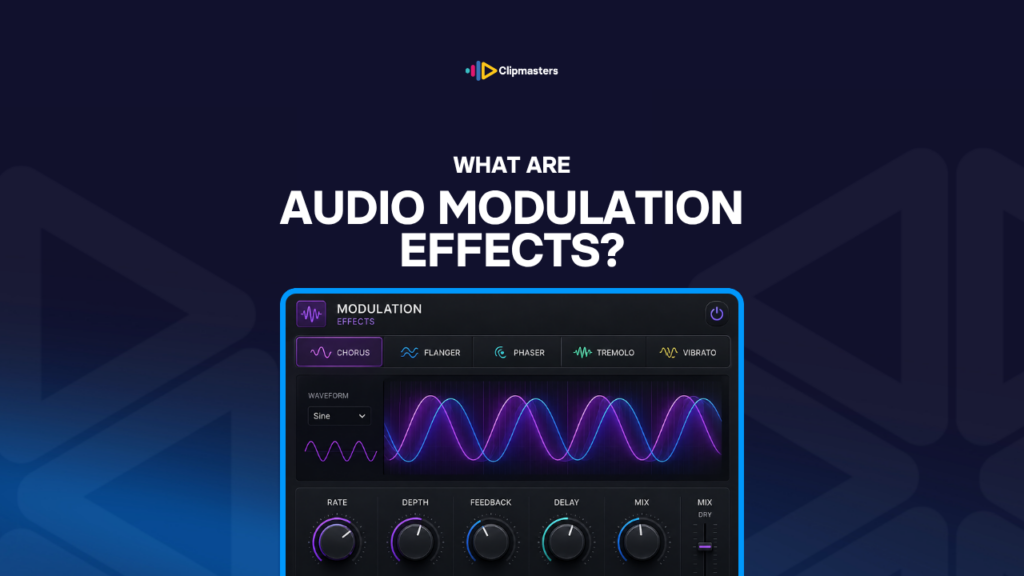
Modulation effects change audio in a repeating, cycling way over time. A slow control signal, called a low-frequency oscillator or LFO, drives changes in pitch, delay, or filtering. The result is a sound that seems to move and shimmer. Each effect changes a different setting and gives a different result.
Here are the common ones:
These effects started in music production, where they create signature sounds. Over time they spread into sound design, voice effects, and all kinds of creative work.
Where they show up in video:
In commercial video work, you will mostly find modulation in music tracks and certain sound design. Standard commercial audio rarely puts heavy modulation on dialogue or the main sound.
Here are a few reasons they are useful.
Distinct character. Each effect has its own sound. Different ones suit different content.
Texture and depth. Chorus fills out thin sounds. The audio feels fuller and more three-dimensional.
Movement and interest. Modulation makes static audio feel alive. The cycling changes keep the listener engaged.
Genre cues. Specific effects signal specific genres. Heavy phaser hints at 70s rock, while modern modulation hints at electronic music.
Brand sound. A brand’s audio identity can use specific modulation choices. The sound becomes recognizable.
Atmosphere. Modulation builds atmospheric sound design. Sci-fi, fantasy, and supernatural content all benefit.
Distinct voices. Heavily modulated voices stand apart from natural ones. Character voices, alien voices, and supernatural voices all use it.
Music depends on it. Music leans heavily on modulation. Without it, sound design loses essential character.
New possibilities. Modulation creates sounds that do not exist in nature. The creative palette grows.
Quiet enhancement. A subtle touch of modulation can improve audio without being obvious. It adds character without drawing attention.
In commercial work, modulation lives mainly in music. Specific sound design moments use it too. Most dialogue and main audio leaves it alone.
For music videos, electronic content, and sci-fi or fantasy work, modulation is foundational. Those genres rely on it.
Here is how the work usually goes.
Pick the effect for the job. Each one gives a different result. Chorus for thickening, flanger for sweeping, phaser for swirling. Match the effect to the sound you want.
Use plugins. Most editing software has modulation effects built in, or supports plugins that add them.
Adjust the settings. Rate, depth, and mix all shape the result. Small adjustments give subtle effects, and bigger ones give obvious effects.
Apply it carefully. Heavy modulation on dialogue makes it hard to follow. Keep it mainly on music and sound effects, and reserve it for specific dialogue moments.
Pair it with other processing. Modulation often works alongside EQ, compression, and reverb. The full chain shapes the final sound.
Automate when it helps. Some effects benefit from automation, where the rate or depth changes through a clip for a dynamic feel.
Test the result. Modulation can be subtle or bold. Check that it does what you intended and adjust if not.
Note brand settings. For brand work, write down the specific settings you used. Future projects can match the same sound.
Skip the stock presets. Default presets often sound generic. Customizing the settings gives a more distinctive result.
Mind the playback. Some effects travel across devices better than others. Test on everyday consumer speakers.
For most commercial work, modulation lives in music and specific sound design. Standard mixing does not usually involve heavy modulation.
Here are a few things that go wrong.
Too heavy on dialogue. Heavy modulation makes dialogue hard to follow. Keep it subtle for dialogue effects.
Wrong effect for the content. Chorus where phaser was needed, or the reverse. Different effects give very different results.
Overusing it. Heavy modulation everywhere gets tiring. Selective use works better.
Generic preset sound. Stock presets that sound like every other amateur project. Custom settings stand out.
Predictable use. The same effect in the same obvious spots, like chorus on every guitar or flanger on every transition. It starts to feel formulaic.
Mismatched genre. 70s rock effects on modern brand content, or modern electronic effects on a period piece. Match the era and the genre.
Bad effect stacking. Heavy modulation piled on heavy distortion and heavy reverb turns into muddy chaos. A cleaner chain works better.
No playback check. Modulation that sounds fine on studio monitors but wrong on regular speakers. Test on real-world devices.
Wrong context. Heavy modulation on content that should sound natural. The effect undercuts the realism.
Random rates. Modulation rates that do not line up with the music or the content’s rhythm. The cycling feels disconnected.
For commercial work, careful modulation is part of audio production. Strong use serves the content. Weak use makes audio feel heavy-handed or out of place.
Modulation belongs mostly to music and specific sound design, not everyday commercial audio. Your editor knows when it serves the content and when natural sound is the better call, so dialogue stays clean and music gets the character it needs. It is handled as part of the edit, not bolted on for the sake of it.
Both thicken sound with delayed copies. Chorus uses longer delays and no feedback, giving a "many voices" effect. Flanger uses shorter delays with feedback, giving a swooping sweep. The difference comes down to the delay time and the amount of feedback.
Mostly, yes. Music production uses them heavily, and sound design uses them for specific effects. Standard dialogue and main audio in commercial video rarely uses modulation. Its home is music, and video reaches for it only now and then for specific moments.
Yes. A light touch of modulation adds depth and character without being obvious. Used carefully, it improves audio without drawing attention to itself. It is not all or nothing, and the small settings matter.
Modern audio editing software has modulation effects built in, like chorus, flanger, and phaser. For specialized or higher-quality results, plugins add more. Most commercial work can use the built-in tools, while advanced or specific work may benefit from dedicated plugins.
For specific character effects, like alien, supernatural, robotic, or comic voices. Standard dialogue should rarely have it. Use modulation on voice only when the character or effect really calls for it.