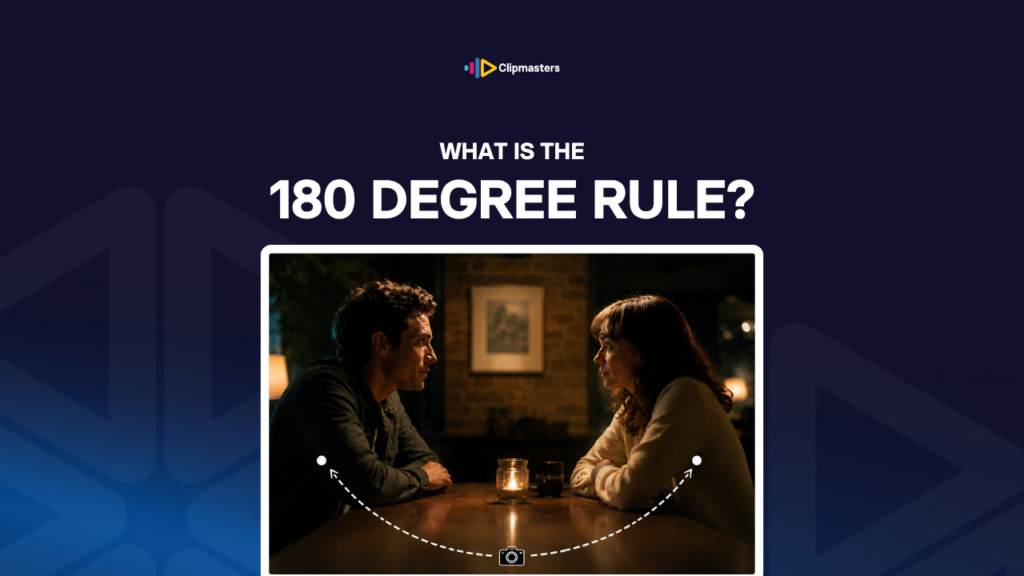
Picture two people having a conversation. Draw an imaginary line connecting them. That line is the 180-degree line, sometimes called the “axis of action.”
The 180-degree rule says: keep the camera on one side of that line for all the shots in the scene.
Why? Because when the camera stays on one side, the way the two people sit in relation to each other stays the same from cut to cut. If person A was on the left and person B was on the right in the wide shot, A stays on the left and B stays on the right in every shot after that. Your brain easily keeps track of who’s where.
If the camera crosses the line, everything flips. Person A, who was on the left, now appears on the right. Person B, who was on the right, now appears on the left. The cut feels off, and viewers lose their sense of where people are in the scene.
This is one of the basic conventions of film grammar. Almost every film and video uses it without anyone thinking about it. It’s how an audience instinctively follows a two-person conversation without getting lost.
The rule shows up most clearly in two-person dialogue, but it applies to any scene with a clear sense of space:
In all of these, crossing the line between cuts throws the viewer off. Staying on one side keeps the space clear.
The 180-degree rule exists because our eyes and brains expect things to stay consistent. When that consistency breaks for no clear reason, the brain has to work harder to understand the scene.
Here are a few specific problems that crossing the line creates:
Disorientation in dialogue. When two people are talking and the camera crosses the line, the viewer briefly thinks one of them has moved. They have to reset before they can follow the conversation again. Even if it takes a fraction of a second, the cut feels wrong.
Confusion about direction. In a chase or action scene, crossing the line makes it look like the runner has reversed direction. The viewer thinks, “wait, weren’t they going that way?“
Loss of a sense of place. In a longer scene with lots of cuts, crossing the line again and again makes the location feel unstable. The viewer can’t build a mental map of the space.
Cuts that feel wrong for no obvious reason. Even when viewers can’t name the rule, they feel it when it’s broken. The cut just doesn’t read as smooth.
For professional work, respecting the 180-degree rule is part of the baseline that audiences expect. Films and TV that break it by accident look amateur. Films that break it on purpose use it as a deliberate choice, for a clear reason.
The 180-degree rule is a convention, not a law. Skilled directors break it on purpose for specific effects.
To show disorientation. When a character is confused, drunk, drugged, or losing control, crossing the line shows that state on screen. The audience feels the character’s disorientation.
To signal a shift. Breaking the line at a key moment in a conversation can hint that the relationship between the characters has fundamentally changed.
For action scenes. Some action sequences cross the line over and over to create visual chaos that matches the chaos of the action. Bourne Identity-style action does this constantly.
For a stylistic look. Some directors, like Jonathan Glazer, Park Chan-wook, and Stanley Kubrick, cross the line as a signature choice. It tells viewers the usual rules of cinema don’t apply here.
To break the fourth wall. When a character looks straight at the camera or a scene turns self-aware, crossing the line reinforces that the normal film grammar has been broken.
The pattern is simple: break the rule when there’s a clear story or style reason. Don’t break it because of a mistake on set.
A few practical habits keep the 180-degree rule working for you.
Find the line before you start shooting. For any scene with two subjects, spot the imaginary line between them. The camera stays on one side of it for the whole scene.
Use a master shot to set up the space. A wide shot that shows where everyone is in the room sets up the relationship. The close-ups that follow inherit that relationship from the master.
Watch the eyelines. When characters look at each other, their eyelines should match across cuts. Person A looks right toward person B, then a cut to person B looking left toward person A. If both characters seem to look the same way, the audience reads them as not actually facing each other, even if they are.
Mark the line for the crew. Some sets put tape or chalk on the floor to mark the line, so the camera operator knows the boundary they can’t cross.
Use a neutral shot to cross the line safely. If a scene really needs to cross the line, put a neutral shot in between, like a wide shot, a cutaway to an object, or a tracking shot that follows the camera across. That gives the viewer a visual bridge. The brain accepts the cut because it saw the camera move.
Plan for it in your coverage. When you shoot a scene, capture coverage from both sides of the line if you might need it. Then in the edit, you can pick which side to treat as the “correct” one.
For run-and-gun documentary or news work, the rule is harder to keep because the camera is chasing action that won’t wait for proper coverage. The basic idea still holds: try to keep your shots on one side of the line, and if you cross it, do it visibly so the audience can follow.
The 180-degree rule is invisible when it’s followed and disorienting when it’s broken, and catching those breaks is a normal part of what a good editor does. A dedicated editor spots line crossings during the first pass and either skips them through shot selection or hides them with cutaways and movement. Footage shot with the rule in mind cuts smoothly. When it wasn’t, the editor quietly does the work to make the cuts feel natural anyway.
The way the subjects sit in the frame flips. A person who was on the left now appears on the right. Even if viewers can't name the problem, they feel disoriented for a moment while they reset. The cut reads as wrong, even when nothing else in the scene is off. Break it over and over and the whole scene starts to feel unstable.
Yes, and skilled directors do it regularly. Breaking the rule on purpose can show a character's disorientation, signal a shift in the relationship, create chaos in an action scene, or work as a stylistic signature. The key is doing it on purpose. Breaking it as a careful storytelling choice works. Breaking it by accident reads as amateur.
For two subjects in a scene, draw an imaginary line connecting them. That's the 180-degree line. The camera should stay on one side of it for all the shots in the scene. For more complex scenes, with several subjects or movement, the line follows the main action or the eyeline between the key subjects. With practice, spotting the line becomes automatic.
A modified version, yes. For a single person talking to the camera or to an off-camera interviewer, the "line" runs along the direction they're facing. Multi-camera coverage of one interview should stay on one side of that line so the eyeline stays consistent across cuts. Switching sides, so the subject suddenly faces the other way across a cut, feels disorienting even with just one person.
A few options. Choose different shots that don't have the problem. Use a cutaway between the bad shots to give viewers a visual bridge. Use a wide shot or insert as a transition. Or flip the frame horizontally in editing, though that only works if there's no text or directional detail in the shot. Sometimes the only option is to live with it and hope viewers don't notice.