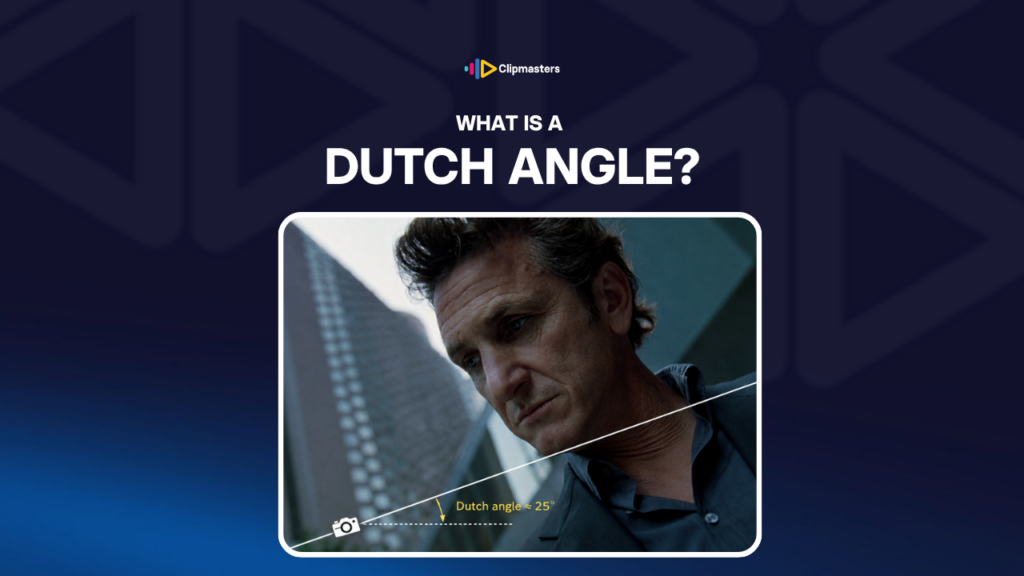
A Dutch angle is a shot where the camera is tilted on purpose, so the horizon runs at a slant across the frame instead of staying level. Everything in the shot leans to one side. The effect is unsettling: the world looks off-balance.
It is one of cinema’s oldest ways of telling you that something is wrong. It is used to suggest:
How far you tilt is up to you. A gentle tilt of a few degrees creates a vague sense of unease that the audience barely notices on purpose. A strong tilt of 15 to 30 degrees makes the slant obvious and dramatic. Both work. It depends on how loud you want the effect to be.
In commercial and online work, Dutch angles are used sparingly. A music video might use them all the way through. A brand film might use one or two for emotional weight. A corporate video almost never. The technique is too strong to use as a default, so it comes out when the moment really calls for it.
The name “Dutch angle” is a bit of a historical mix-up. The technique has nothing to do with the Netherlands.
It comes from German Expressionist cinema of the 1920s, films like The Cabinet of Dr. Caligari (1920), Nosferatu (1922), and Metropolis (1927). Those filmmakers leaned hard on tilted angles to show inner turmoil and a world in chaos.
When the technique got written about in English film criticism, the German roots got a little garbled. The German word “Deutsch,” meaning German, got mistranslated to “Dutch,” meaning the Netherlands, in some early writing. The mistake stuck. By the time people noticed the error, “Dutch angle” was already the standard term across the industry.
The technique goes by a few other names too:
In film schools and on professional sets, “Dutch angle” or “Dutch tilt” is what people say. The mistranslation is here to stay.
Some directors and films are closely tied to this technique.
German Expressionism (1920s to 30s). The Cabinet of Dr. Caligari uses heavily tilted sets and Dutch angles throughout to show the unreliable mind of its narrator. Nosferatu uses them for moments of supernatural dread. The tilt was a core part of the German Expressionist look.
Carol Reed’s “The Third Man” (1949). Often seen as the most famous English-language use. Reed uses Dutch angles widely to make post-war Vienna feel unstable and morally murky.
Tim Burton. Almost every Burton film features Dutch angles, often as part of his slightly off-kilter visual signature.
Sam Raimi’s “Evil Dead” films. Heavy use of Dutch angles to convey supernatural threat and disorientation. The technique became part of the horror toolkit partly through Raimi’s influence.
Christopher Nolan’s “Inception” and Batman films. Used selectively for moments of mental pressure or moral compromise. Less constant than Burton or Raimi, but a steady thread across his work.
Music videos. Heavy use across the genre, especially for high-energy or emotional moments.
Superhero films. Common in action scenes, especially when characters are losing control of a situation or under attack.
The technique works because it breaks an expectation. We expect horizons to be level. When one is not, the brain senses something is wrong before it even works out why.
Dutch angles are powerful, but easy to overuse. The technique works best when it is earned.
Use a Dutch angle when:
Avoid a Dutch angle when:
The common mistake is using a Dutch angle to stand in for content. A scene with no real tension does not become tense because the camera is tilted. It just looks confused.
For commercial and online work, Dutch angles tend to show up most in:
In day-to-day talking-head content, product videos, and corporate work, Dutch angles are rare. They read as too aggressive for those formats.
The Dutch angle is tempting because it adds instant visual interest. The real skill is knowing when to leave it alone. A scene that needs a tilt to feel interesting usually has a deeper problem: the framing or the action is not doing enough on its own. At Clipmasters, your editor reaches for the tilt only in moments that earn it, so when it does show up, it still lands hard instead of numbing the audience.
The name is a mistranslation. The technique comes from 1920s German Expressionist cinema, and the German word "Deutsch," meaning German, got turned into "Dutch," meaning the Netherlands, in early English film writing. The mistake became standard before anyone fixed it, and "Dutch angle" stuck as the industry term, even though it has nothing to do with the Netherlands.
A subtle Dutch angle tilts the camera about 5 to 10 degrees off level. A strong one tilts 15 to 30 degrees. Beyond 30 degrees it starts to feel extreme, almost cartoonish. The amount depends on how loud you want the effect. A subtle tilt creates a vague unease; a strong tilt makes the technique obvious and dramatic.
When the moment genuinely needs it: a character is in distress, the scene needs to feel unstable or threatening, or you want a deliberate stylistic touch. Avoid using it randomly or as a stand-in for content. The technique works because the moment earns it. Overuse numbs the audience and the effect stops landing.
Yes, in everyday use. A Dutch angle specifically means a deliberately tilted camera, with the horizon running at a slant. A tilted shot is the same thing, and "Dutch tilt" is another name for it. All three describe the same effect: the horizon slopes instead of staying level.
Yes, by rotating the clip in editing software. The result is close to a tilt done in-camera, with a couple of differences. Rotating a widescreen clip brings in black corners that you have to crop out, which slightly shrinks the usable image. Some footage handles the rotation cleanly and some does not. For shots planned around a Dutch angle, capturing it in-camera gives better results than adding it later.