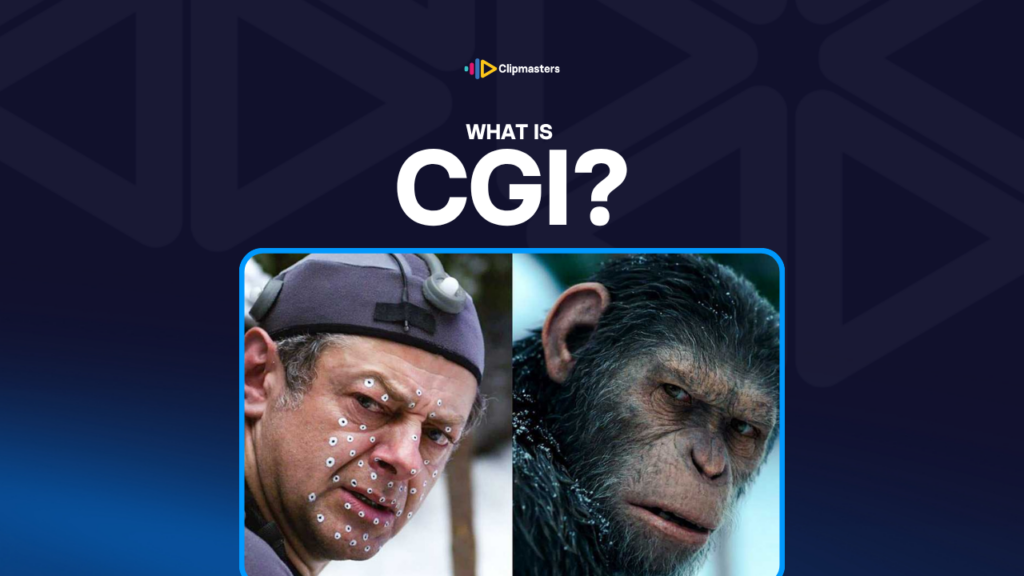
CGI

CGI, or computer-generated imagery, is visual content created entirely on a computer, often added to live-action footage to show things that couldn’t be filmed.

In this article

Related Terms

Start Video editing now

What is CGI?

CGI stands for Computer-Generated Imagery. The term covers anything drawn, rendered, or animated entirely on a computer rather than caught by a camera.

Here is what CGI gets used for:

  • Creatures and characters. The dinosaurs in Jurassic Park, Gollum in Lord of the Rings, every Marvel character who is not just a person in makeup. They are built in 3D software and rendered frame by frame.
  • Environments. Cityscapes, alien planets, historical settings, interiors. Either fully CGI, or used to stretch a real location bigger.
  • Vehicles and objects. Spaceships, complex machines, anything that is hard or impossible to film for real.
  • Effects. Explosions, fire, water, smoke, weather, magic. Often made with simulation software that copies how the real thing behaves.
  • Fixes. Sometimes used to replace something that was filmed but did not work: a stunt that went wrong, a prop that broke, a logo that needs to change.

CGI is most linked with feature films, especially superhero movies, animation, and sci-fi, but it also turns up in commercials, broadcast TV, music videos, and online content. Almost any modern shot that makes you think “wow, how did they do that?” probably has CGI in it.

The edges get a little fuzzy. A fully animated cartoon is CGI. A live-action film with a digital backdrop is also CGI. The term is really about how the imagery was made (on a computer) more than what it shows.

Need editors who handle CGI work as part of regular delivery?

Editors matched to your brand. Turnaround in as little as 24 hours.

CGI vs VFX vs animation

Three terms that often get swapped around but actually mean different things.

Animation is video made entirely on a computer (or hand-drawn frame by frame). No live action. Pixar films are animation. Disney’s hand-drawn classics are animation. Modern animated films use CGI techniques to make the animation, but the genre is still animation.

VFX (visual effects) is the bigger category of visual elements added to video, covering everything from cleanup to compositing to dropping in CGI. CGI is one kind of VFX, but not all VFX is CGI. A green screen background swap is VFX. A microphone removed from a shot is VFX. Neither of those has to be CGI.

CGI specifically means imagery made on a computer. A 3D dinosaur built in animation software is CGI. A digital city skyline rendered from scratch is CGI. Practical effects (real explosions, real stunts, real props) are NOT CGI.

A quick way to tell them apart:

  • A movie with a CGI dragon flying over a real castle: that is CGI dropped into live action, which makes it VFX.
  • A Pixar film with no live action: that is animation, made using CGI techniques.
  • A real person filmed in a real place, with a microphone painted out afterward: that is VFX cleanup, not CGI.

In practice, the three overlap a lot. A modern blockbuster uses all three: CGI characters, VFX integration, and animation sequences, in different parts of the same film.

How CGI is made

The basic CGI workflow runs through several stages, and each one is a specialty of its own.

Modeling. Building the 3D shape of a character, object, or place in software. Think of it like sculpting in clay, but virtual. Tools: Maya, Cinema 4D, Blender, ZBrush.

Texturing. Adding surface detail to the model: skin, fur, fabric, metal, dirt. The model goes from a plain gray shape to something you recognize. Tools: Substance Painter, Mari.

Rigging. Building a virtual skeleton inside the model so it can move. Without rigging, the model is just a frozen shape. Tools: Maya, Blender.

Animation. Moving the rigged model over time to make it act. Either keyframed (an animator sets the poses) or motion-captured (a performer’s movements are recorded and applied to the model). Tools: Maya, Blender, Motion Builder.

Lighting. Placing virtual lights in the 3D scene so the model is lit. This is the CGI version of cinematography. Tools: built into the 3D software.

Rendering. Calculating the final image from the 3D scene, frame by frame. Each frame can take seconds or hours to render, depending on how complex it is. Tools: Arnold, Redshift, V-Ray, Cycles.

Compositing. Combining the rendered CGI with live footage and other pieces. This is where CGI most often meets the real world. Tools: Nuke, After Effects, Fusion.

For everyday commercial and online work, full CGI is rare. Most CGI in that space comes from stock libraries or ready-made assets. Custom CGI is saved for projects with bigger budgets and longer timelines.

CGI in commercial and online work

CGI shows up in commercial and online video too, just on a smaller scale than in feature films.

Showing off products. A car company without a finished prototype can show the car in CGI. Tech companies render their products in CGI for marketing. Furniture, consumer goods, and jewelry are all commonly rendered.

Explainer videos. Animated explainers that show abstract ideas (a company’s software, a chemical process, a concept) are usually built in CGI animation rather than filmed.

Logo animation and motion graphics. 3D motion graphics, like a brand logo spinning or an animated 3D chart, are CGI work, even though people often just call them “motion graphics.”

Building visualizations. Showing a building before it is built, for marketing or investor pitches. This is heavy CGI work.

Stock CGI assets. A lot of commercial CGI comes from libraries: 3D models, motion graphics templates, animated icons. These can be tweaked and dropped into a project without paying for custom CGI.

The choice to use CGI in commercial work usually comes down to one question: is the real thing too expensive, too dangerous, or impossible to film? If yes, use CGI. If the real thing is cheaper and easier, that is almost always the better call. CGI is expensive because it takes a lot of hours. Live action is expensive in other ways (locations, crew, gear) but often cheaper for the same end result.

How Clipmasters Uses This

CGI is the most expensive kind of visual content per second of finished video. A single CGI character can cost more than a whole commercial shoot, and that reality shapes how a smart editor uses it. A Clipmasters editor saves CGI for the moments that truly need it, like a product that can’t be filmed, and reaches for live action, motion graphics, or stock CGI for everything else. Knowing when a simple 2D motion graphic does the same job as a costly 3D render is exactly the kind of judgment that keeps your budget working for you.

Frequently asked questions

What's the difference between CGI and VFX?

VFX is the bigger category of visual effects added to video. CGI is one kind of VFX, specifically meaning imagery made entirely on a computer. A composited green screen shot is VFX. A 3D dinosaur is CGI (and also VFX). All CGI is VFX, but not all VFX is CGI.

When did CGI start being used in film?

Early CGI showed up in films like Westworld (1973) and Star Wars (1977). The first major CGI character was the Stained Glass Knight in Young Sherlock Holmes (1985). Jurassic Park (1993) is widely seen as the breakthrough that made CGI look real enough to convince audiences. From there, CGI quickly took the place of many practical effects in mainstream film.

Is animation the same as CGI?

Modern computer animation is built using CGI techniques (3D modeling, animation, rendering), so the two overlap. But they are not identical. "Animation" describes the type of content (video built from scratch, no live action). "CGI" describes how the visuals were made (on a computer). Hand-drawn animation is not CGI, and CGI used in a live-action film is not animation.

Can AI generate CGI now?

AI tools can now create impressive 2D and 3D imagery from text prompts (Sora, Runway, Veo). For some kinds of work, these tools are starting to replace traditional CGI. But high-end CGI, like Marvel-quality characters, photorealistic environments, and complex simulations, still needs traditional 3D software and skilled artists. AI is making basic CGI easy for non-specialists, but it has not replaced the expert work.

Do I need CGI for my commercial or marketing video?

Usually no. Most commercial and online video uses live action plus motion graphics rather than CGI. CGI earns its place when you need to show something that can't be filmed, like a product that does not physically exist yet, an abstract idea, or a place you can't get to. For everyday work, simpler tools like animated logos, name bars, or 2D motion graphics handle the visuals without the CGI cost.

Loading video…