Wide-Angle Lens

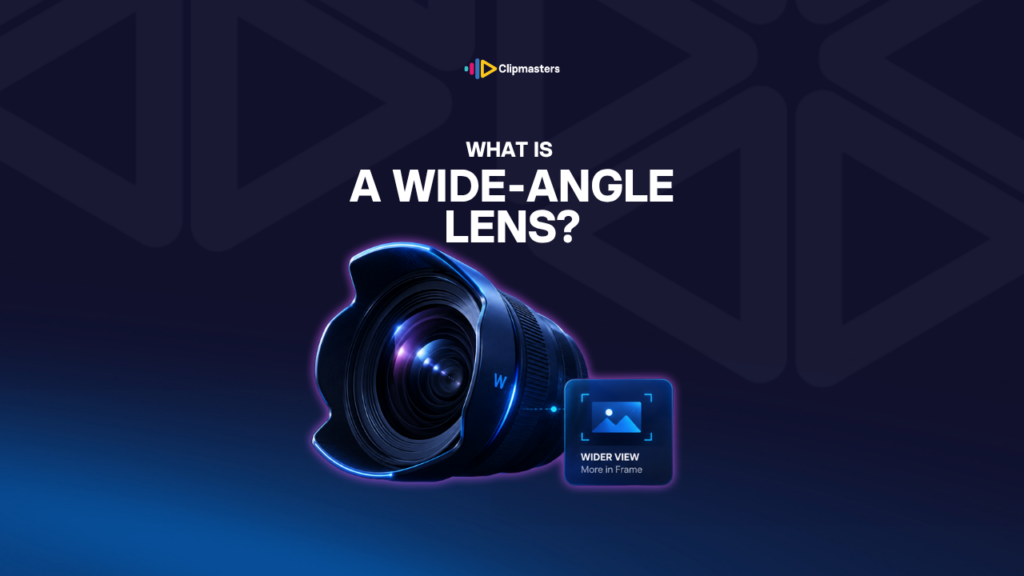
A wide-angle lens has a shorter focal length than a standard lens, so it takes in a wider field of view than normal.

In this article

Related Terms

Start Video editing now

What is a Wide-Angle Lens?

Lenses are described by their focal length, measured in millimetres. The shorter the focal length, the more of the scene the lens takes in. The longer the focal length, the narrower the view.

Here are the rough categories, for full-frame cameras:

  • Ultra-wide: under 24mm. A very wide view with strong distortion. Used for landscapes, architecture, and very tight indoor spaces.
  • Wide-angle: 24 to 35mm. Takes in more than a “normal” view. Common for landscapes, group shots, portraits that show the setting, and any shot that needs context.
  • Standard, or “normal”: 35 to 50mm. Roughly matches what your own eyes see. A flexible, all-purpose lens.
  • Short telephoto: 50 to 85mm. Slightly compressed look. The classic portrait range.
  • Telephoto: 85 to 200mm. Strong compression. Good for separating a subject from the background.
  • Long telephoto: 200mm and up. Extreme compression. Sports, wildlife, distant subjects.

These numbers shift for smaller sensors. On a crop-sensor camera, like APS-C or Micro Four Thirds, an 18mm lens gives you roughly the same view as a 27mm or 36mm lens on full-frame. Phone cameras use very short focal lengths, usually 1.5 to 7mm physically, but their tiny sensors make the view land somewhere in the 24 to 50mm range.

In practice, “wide-angle” describes the look more than an exact number. It’s a lens that takes in more than what feels like a normal view.

Need editors who work fluently with footage from any focal length?

Editors matched to your brand. Turnaround in as little as 24 hours.

What wide-angle lenses do visually

Wide-angle lenses don’t just fit more into the frame. They also change how the scene looks.

Exaggerated perspective. A wide-angle lens makes things in the foreground look bigger compared to things in the background. A subject close to the lens fills the frame, while the same subject at the same distance looks much smaller through a longer lens. This can look great (a hand reaching toward the lens feels dynamic) or unflattering (a face very close to the lens gets a giant nose).

More depth. Wide-angle shots feel more three-dimensional. That stretched foreground-to-background scaling makes the eye read more depth in the frame.

Distortion at the edges. Every wide-angle lens bends straight lines a little near the edges of the frame. The wider the lens, the more you see it. Modern lenses fix most of this in software, but very wide shots still show some.

More in focus. At the same aperture, wide-angle lenses keep more of the scene sharp from front to back. That’s handy for landscapes and setting-focused shots, but it works against you when you want a blurry background behind your subject.

A sense of being there. Wide-angle shots tend to feel like you’re in the room. The viewer feels closer to the scene because more of it is visible. Handheld vlogs use wide-angle lenses partly for this reason.

These qualities make wide-angle lenses better for some shots than others. Knowing what each focal length does is part of any camera operator’s basic toolkit.

When wide-angle lenses are the right choice

Here are the situations where wide-angle is usually the default.

Landscapes. Wide vistas, sweeping views, big natural scenes. The lens captures the breadth that makes a landscape feel impressive.

Architecture and real estate. Indoor spaces where you need to show the whole room, and outdoor shots of buildings. Wide-angle is essential for tight rooms. Without it, you can’t fit the whole space in frame.

Portraits with context. A portrait that shows the subject in their setting, like their workshop, home, or workplace. The wide-angle captures both the person and the environment.

Establishing shots. Wide shots that set up where a scene takes place. Almost always wide-angle.

Action with movement. Skateboarding, surfing, mountain biking. The wide-angle drops the viewer into the action and gives a sense of speed and scale.

Group shots. Lots of people in the frame. Standard or wide-angle lenses fit more subjects without backing the camera way up.

Vlogs and handheld work. Wide-angle lenses are more forgiving of camera shake, because they magnify the subject less, so they magnify the shake less too. The handheld vlog look almost always uses wide-angle.

Tight interiors. Cars, small rooms, kitchens. Wide-angle is the only way to capture the scene at all.

And here’s when wide-angle is the wrong choice:

  • Portraits and beauty work. Wide-angle exaggerates facial features. Portrait lenses (50 to 135mm) flatten the proportions, which most people find more flattering.
  • Distant subjects. A wide-angle lens grabs everything in the scene, including a small distant subject. A telephoto lens isolates that subject and makes it bigger.
  • Blurring the background. Wide-angle lenses keep more in focus, so they’re worse at softening the background. For interview-style shots, 50mm or longer is usually better.

Wide-angle in different production contexts

Here’s how wide-angle lenses show up across different kinds of video.

Feature film and TV drama. Wide-angle lenses (35mm, 28mm, 24mm) are common for establishing shots, big scenes, and stylistic choices. Some directors, like Paul Thomas Anderson and the Coen Brothers, favour wide-angle lenses even for character work as a signature look.

Documentary. Wide-angle is the default for capturing a setting. Documentary shooters often use a single wide-to-mid zoom (16 to 35mm) for run-and-gun work.

Commercial and brand work. A mix. Product shots usually use longer lenses for isolation. Establishing shots and setting footage use wide-angle. Lifestyle commercials lean wide-angle for that “you are there” feeling.

YouTube and online video. Vloggers and creators lean heavily on wide-angle. The selfie-stick handheld vlog look depends on it, usually a 16 to 24mm equivalent on a phone or action camera. Action cameras like GoPros are basically fixed wide-angle.

Real estate video. Almost always wide-angle. The job is to show rooms convincingly, which needs a lens that captures the whole space.

Music videos. Often heavily wide-angle for performance shots, especially with the handheld camera work that’s part of the style.

News and ENG (electronic news gathering). Wide-to-mid zooms are standard. Covering unpredictable live events benefits from the flexibility.

Choosing a focal length is one of the more underrated parts of visual storytelling. Every focal length has a feel, and picking the right one for the moment is part of what separates thoughtful camera work from generic shots.

How Clipmasters Uses This

Wide-angle is one of those tools that gets overused on self-shot content and underused on professional work, mostly because the default phone and action-camera lens is wide. When you hand footage to a dedicated editor, they work fluently with whatever focal lengths you give them and cut it for visual rhythm: the wide establishing shot, then the longer interview close-up. Footage shot at a single focal length all the way through almost always feels flatter than footage where the lens was chosen for each shot.

Frequently asked questions

What focal length is considered wide-angle?

For full-frame cameras, anything under 35mm is generally wide-angle, and 24mm or below is ultra-wide. For crop-sensor cameras, the same view comes from roughly 18 to 23mm (APS-C) or 12 to 17mm (Micro Four Thirds). Phone cameras and action cameras use very short physical focal lengths that produce a wide-angle view because their sensors are so small.

Why do wide-angle lenses distort faces?

Wide-angle lenses exaggerate perspective, so things in the foreground look bigger than things in the background. When the lens is close to a face, the parts nearest the lens (usually the nose) look too big, while the parts further away (ears, sides of the head) look small. That's why portrait shooters usually use 50 to 135mm lenses for close-up face shots. Longer focal lengths compress the perspective and give more flattering proportions.

Are phones wide-angle cameras?

Most phone main cameras give a view roughly like a 24 to 26mm lens on full-frame, which is in the wide-angle range. Phones also usually have a second "ultra-wide" lens with an even wider view (10 to 13mm equivalent). The default phone image has the wide-angle look baked in: lots in focus, slight edge distortion, and a "you are there" feel.

When should I use a wide-angle lens vs a telephoto?

Use wide-angle for context, environment, action, and tight spaces where you can't back up. Use telephoto for separating a subject from the background, distant subjects, flattering portraits, and a compressed look. A talking-head interview usually looks better on a short telephoto (50 to 85mm) than on a wide-angle lens. An establishing shot of a city skyline almost always uses wide-angle. Different focal lengths serve different parts of the story.

Can I use a wide-angle lens for interviews?

You can, but it usually doesn't look as flattering as a longer lens. Wide-angle lenses tend to distort facial features and pull in too much background, which can compete with the subject. For most interviews, a 50 to 85mm equivalent gives more polished results. Wide-angle works for interviews in tight spaces, like cars or small rooms, where you have no choice, and for a deliberate "in their environment" look that includes the setting.

Loading video…