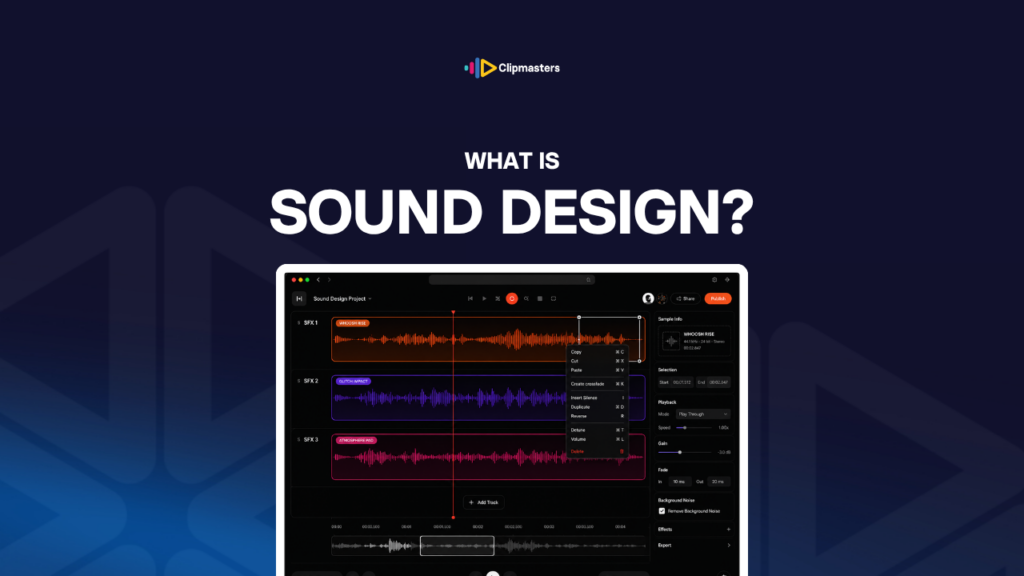
Sound design is the layered audio work that makes a video feel like a real experience instead of a string of images. It is everything in the mix that is not dialogue or music: sound effects, ambient backgrounds, transitions, foley, and the overall feel of the audio.
A sound designer’s job is to think about what the video should sound like, not just what it shows. A scene of someone walking through a forest is not only visual. It has crunching leaves, distant birds, wind in the branches, maybe a creek off-screen. None of that needs to be on camera. It just makes the scene feel real.
The pieces of sound design:
Sound design is separate from music (which has its own composer or song choice) and from dialogue (which comes from the production audio or ADR). All three layers come together in the final mix.
Sound design is one of the most underrated parts of finishing a video. Most viewers never notice it on purpose, but it shapes how the video feels.
A few specific things sound design does:
For commercial and online video, sound design is often the line between feeling professional and feeling amateur. Great visuals with thin sound design feel unfinished. Decent visuals with strong sound design can feel polished.
In any video’s audio mix, three layers work together.
These three layers do different jobs:
In the final mix, you balance all three. Dialogue should be loudest, music sits below it, and sound design usually sits at or below the music. Specific moments, like a dramatic sound effect or a music swell, might briefly jump louder for emphasis.
The balance shifts by genre:
The sound design workflow changes with the size of the project.
For a high-end feature film, there is a whole team: sound designers, foley artists, ADR engineers, dialogue editors, music editors, and a re-recording mixer. Each one handles a different layer, and weeks or months go into the final mix.
For commercial work, it is usually one sound designer working alongside the editor. They take the locked picture and build the audio from sound libraries plus custom-designed elements. A typical 60 to 90 second commercial might take 1 to 3 days of focused sound work.
For online video and YouTube, often the same editor does both the visuals and the audio. Sound libraries like Epidemic Sound, Artlist, Soundsnap, and Freesound provide the raw material. The editor picks the sound effects, ambient beds, and music, then mixes them together.
The basic process:
The tools: Pro Tools is the industry standard for sound design and audio post. Logic Pro, Ableton Live, and Reaper show up in some workflows. Most video editing software (Premiere Pro, DaVinci Resolve, Final Cut Pro) has built-in audio tools that are plenty for most online video.
Sound design is one of the highest-leverage finishing tools in video, because the visuals carry most of the conscious attention while the sound carries most of the feeling. A good editor treats it as real creative work, not a checklist, so picking the right sound effect for a moment matters as much as picking the right shot. At Clipmasters, building ambient layers and choosing sounds that actually fit the moment is part of how your editor finishes the edit, not an afterthought tacked on at the end.
Sound design covers sound effects, ambient sound, transitions, and atmosphere. Music is the score or song under the video. Both are non-dialogue layers, but they do different jobs: music shapes how you feel, and sound design builds the world you hear. Most videos use both, balanced together with the dialogue in the final mix.
Some level, yes. Even talking-head videos benefit from basic sound design: ambient room tone under the dialogue, subtle effects on motion graphics, and music that supports the content. How much you invest scales with the project, but no sound design at all almost always feels flat. Even 30 minutes spent adding ambient layers and a few key effects makes a noticeable difference.
A few places. Paid libraries (Soundsnap, Boom Library, Pro Sound Effects) for high-quality sounds. Free libraries (the BBC Sound Effects Archive, Freesound.org, the YouTube Audio Library) for budget options. Custom recordings, like foley sessions or location audio, for specific needs. AI-generated sound is starting to appear for niche cases. Most pros also build up their own curated library over many projects.
For a 60 to 90 second commercial, 1 to 3 days of focused work. For a feature film, weeks to months for a full team. For a 10-minute YouTube video, 2 to 4 hours for moderate sound design, less if the structure is simple. The time scales with both the length of the video and how complex the sound design is. A talking-head video needs less, and a sound-heavy narrative film needs much more.
Partly. AI tools can generate ambient sound from text prompts (Stable Audio, ElevenLabs Sound Effects, and others), match music to video automatically, and find effects from libraries based on context. But choosing the right sounds for a specific moment, building emotional layers, and weaving sound into the picture still benefits from a human. AI is becoming a useful assistant in sound design, but it has not replaced the craft.